
Free Safe Operating Procedure (Catering Cart Handling) Template
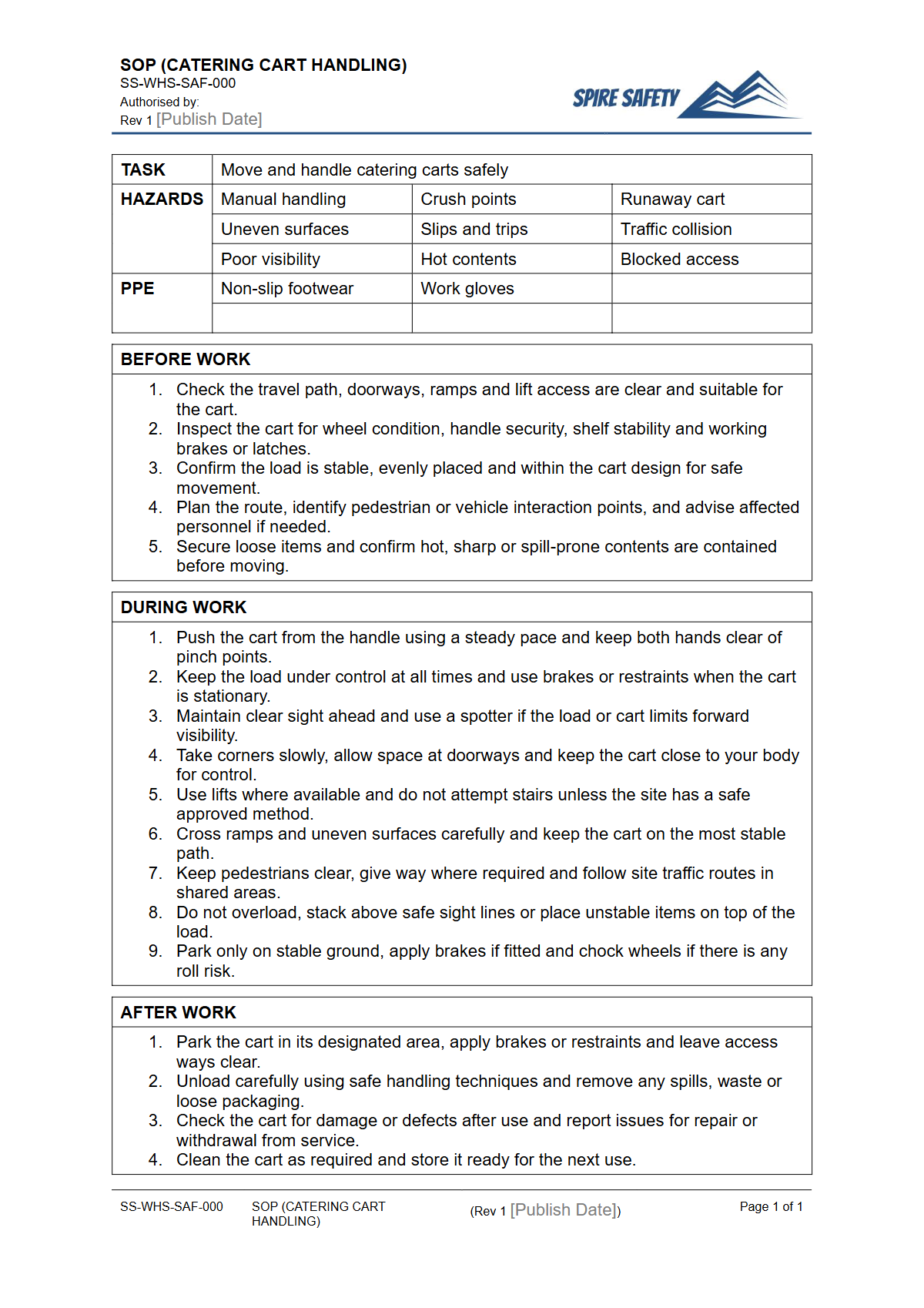
Download our free Safe Operating Procedure (Catering Cart Handling) Template. This Word & PDF document provides a structured starting point for your WHS system.
Free Safe Operating Procedure (Catering Cart Handling) Template
DOCX • 126 KB + PDF
Updated Oct 2026
No signup required
Purpose of the Free Safe Operating Procedure (Catering Cart Handling) Template
Effectively managing workplace health and safety in industries like hospitality, aviation, and event management requires clear, documented processes for high-risk tasks. This free Safe Operating Procedure (Catering Cart Handling) Template provides a structured starting point for your organisation to formalise its safety protocols.
The primary goal is to control the risks associated with moving loaded and unloaded catering carts, which include musculoskeletal injuries from pushing, pulling, and lifting; slips, trips, and falls; and collisions with people or property.
By implementing a detailed SOP, you create a consistent, safe method for workers to follow, significantly reducing the likelihood of incidents. This document serves as a vital tool for training, inductions, and ongoing competency checks.
It forms a key component in a proactive safety culture and aids in the process of developing robust WHS management systems that demonstrate due diligence and a commitment to worker safety.
Video walkthrough
How to use the Free Safe Operating Procedure (Catering Cart Handling) Template
This downloadable document is provided in both DOCX and PDF formats for your convenience. The DOCX version is fully editable, allowing you to tailor it to the specific carts, layouts, and hazards present in your workplace.
It is designed to be a foundation, not a finished document, and requires careful customisation to be effective and relevant.
To adapt this template correctly, follow these steps:
- Consultation: Engage with the workers who actually handle the catering carts. Their firsthand experience is invaluable for identifying practical risks and effective control measures.
- Site-Specific Details: Add details unique to your environment. This includes specific cart models, load limits, designated pathways, storage procedures, and any environmental challenges like ramps, uneven surfaces, or tight corners.
- Risk Assessment: Ensure the controls listed in the SOP align with your own WHS consulting-led risk assessment for the task. You may need to add, remove, or modify steps based on your findings.
- Associated Tasks: Consider all related activities. For example, if loading or unloading carts involves reaching items on high shelves, you should integrate procedures from your SOP for step ladder use.
- Review and Approval: Once customised, have the SOP reviewed and approved by a competent person within your organisation, such as a WHS manager or supervisor, before it is implemented.
Important: This is a template that we have created as a starting point. You must customise it to reflect the specific hazards, equipment, and procedures in your workplace. Responsibility for its accuracy and suitability remains with the user.
When to use it
A Safe Operating Procedure for catering cart handling should be used as a primary reference document in several key situations. It is essential for the induction and training of all new employees who will be required to perform this task.
It should also be used for refresher training to ensure standards do not slip over time.
The SOP must be readily accessible in the work area for quick reference. It should also be a central document during incident investigations involving catering carts, helping to determine if procedures were followed.
Furthermore, the SOP should be reviewed and potentially updated whenever there is a change in equipment, work environment, or after a near miss or incident occurs. Regular reviews as part of your WHS compliance auditing schedule ensure it remains current and effective.
Who should use it
This SOP is intended for use by a range of personnel within an organisation. The primary users are the workers themselves, including catering staff, flight attendants, event staff, hotel porters, and kitchen hands who physically handle the carts.
It provides them with clear, step-by-step instructions on how to perform their duties safely.
Supervisors and managers are also key users. They are responsible for ensuring workers are trained on the SOP, that its procedures are being followed correctly, and for conducting periodic reviews and observations.
For organisations involved in large-scale logistics, the SOP should also consider the interface with transport, which may involve separate procedures detailed in documents like a Safe Operating Procedure for body trucks. Lastly, WHS personnel will use the SOP as a tool for risk management, training development, and auditing purposes. Explore our complete free WHS resources library for more templates to support your safety system.
Common mistakes
Common mistakes to avoid
- Overloading carts beyond their rated capacity or to a point where the view is obstructed.
- Failing to check that wheels are clean, roll freely, and that brakes are functional before use.
- Using poor manual handling techniques, such as twisting the back while pulling or pushing.
- Leaving carts unattended on slopes or in high-traffic areas without engaging the brakes.
Legal references
Legal considerations
The following legal requirements may be relevant to this type of work.
- Work Health and Safety Act (Harmonised) — Provides the primary duties for protecting workers and other people from work health and safety risks.
- Work Health and Safety Regulations (Harmonised) — Sets out requirements supporting the management of workplace hazards and risks.
The following codes may be relevant to this type of work.
- Managing WHS Risks Code of Practice — Provides practical guidance on identifying hazards, assessing risks and applying effective controls.
- Work Health and Safety Consultation, Cooperation and Coordination Code of Practice — Provides practical guidance on consulting workers and coordinating with other duty holders.
- Managing the Work Environment and Facilities Code of Practice — Provides practical guidance on safe work environments, workplace facilities and related controls.
Did you know
Cart Weight
A fully loaded, full-size airline catering cart can weigh over 100 kilograms, posing a significant manual handling risk if not managed correctly.
Common Injury
Work-related musculoskeletal disorders are one of the most common types of workplace injuries in Australia, with hazardous manual tasks being a leading cause.
FAQ
Frequently asked questions
01What are the main hazards of handling catering carts?
02Does this Safe Operating Procedure cover food safety requirements?
03How often should an SOP for catering cart handling be reviewed?
04Is specific training required to handle catering carts safely?
Share this resource
Free Safe Operating Procedure (Catering Cart Handling) Template
Browse Categories
How To Use It
- 1Download and open in Word or PDF.
- 2Replace the placeholders with your business details.
- 3Get it reviewed by a WHS specialist before rollout.
Need it customised?
Our WHS consultants can adapt this template to your site, run a gap analysis, or audit what you already have in place.
Book a Free Consultation WHS consulting servicesor call 1300 156 382
Related templates
- Free Safe Operating Procedure (Cattle Drafting) Template
- Free Safe Operating Procedure (Cattle Feeding) Template
- Free Safe Operating Procedure (Cattle Footbath) Template
- Free Safe Operating Procedure (Cattle Loading Ramp) Template
- Free Safe Operating Procedure (Cattle Loading) Template
- Free Safe Operating Procedure (Cattle Race) Template