
Free Safe Operating Procedure (Cattle Feeding) Template
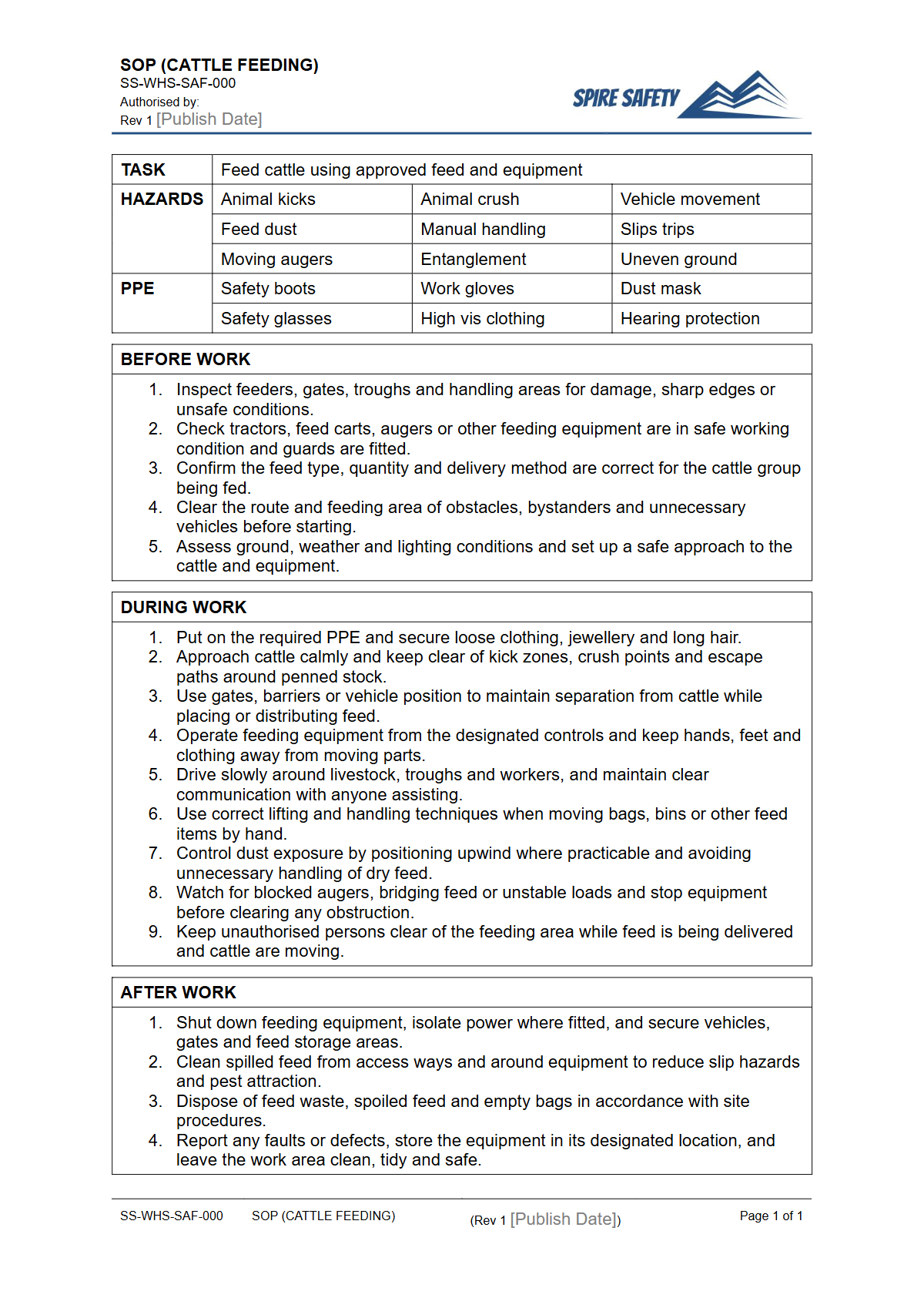
Download our free Safe Operating Procedure (Cattle Feeding) template. This DOCX & PDF resource helps manage risks on Australian farms. Customise it today.
Free Safe Operating Procedure (Cattle Feeding) Template
DOCX • 126 KB + PDF
Updated Oct 2026
No signup required
Purpose of the Free Safe Operating Procedure (Cattle Feeding) Template
Working on farms, particularly with livestock and machinery, presents a unique set of safety challenges. This free Safe Operating Procedure (Cattle Feeding) template provides a structured starting point for documenting the step-by-step process for safely feeding cattle.
An SOP serves as a critical tool for risk management, standardising work methods to minimise the chance of injury to workers or harm to animals. It identifies potential hazards—such as machinery entanglement, animal behaviour, dust exposure, and manual handling risks—and outlines specific control measures to mitigate them.
A well-developed SOP is a cornerstone of effective WHS management systems, demonstrating a commitment to workplace safety.
By formalising procedures, you create a consistent benchmark for performance and safety. This document can be used as a primary training resource for new employees and a refresher for experienced workers.
It helps ensure that everyone performing the task understands the safest, most efficient method as determined by the business. Documenting procedures for common farm tasks, including those requiring heavy equipment like dozers, is a key part of managing operational risk.
For related earthmoving tasks, you may also find our FREE Dozer SOP (Safe Operating Procedure) Template a useful resource.
Video walkthrough
How to use the Free Safe Operating Procedure (Cattle Feeding) Template
This Safe Operating Procedure for cattle feeding is a downloadable template, available in both DOCX and PDF formats, designed for customisation. It is not a complete, out-of-the-box solution.
To make it effective for your specific operation, you must adapt it to reflect your unique environment, equipment, and processes. This involves consulting with the workers who perform the task daily, as their input is invaluable for identifying practical risks and effective controls.
When customising the template, be sure to include details such as:
- The specific types and models of machinery used (e.g., feed-out wagons, tractors, mixers).
- The types of feed and any associated handling requirements (e.g., silage, hay bales, grain).
- Site-specific details, such as the layout of paddocks, laneways, and feeding areas.
- Emergency procedures, including contact information and shutdown sequences for machinery.
Remember, we have created this template as a guide; you must take responsibility for ensuring it accurately reflects the tasks and risks in your workplace. Many farms use versatile machinery for feeding, and if your process involves a telehandler, our telehandler SOP template offers more specific guidance for that equipment.
When to use it
A Safe Operating Procedure for cattle feeding should be used consistently as part of your daily farm operations. It is not a document to be filed away and forgotten.
It should be readily accessible to all relevant personnel near the work area. Key times to use and refer to the SOP include during the induction and training of new farmhands, as a pre-start checklist before beginning the feeding task, and as a reference during toolbox talks to reinforce safe work practices.
The SOP is also a critical document for review following any near miss or incident, helping to identify procedural gaps that may need addressing. Similar to how you would reference a grain drill SOP template before seeding, this document should be an active part of your pre-operational routine.
Who should use it
This SOP is intended for use by anyone involved in the cattle feeding process on a farm. This includes farm owners and managers (Persons Conducting a Business or Undertaking or PCBUs), who are responsible for developing and implementing safe systems of work.
Supervisors should use it to train and monitor workers, ensuring procedures are followed correctly. Most importantly, the farm workers and operators who physically carry out the task should use the SOP as their guide to performing the job safely.
During a formal safety review, documents like this are essential evidence of implemented controls, which is a key focus of any WHS compliance auditing process. By involving everyone in its use, the SOP becomes a living document that promotes a stronger safety culture across the entire organisation.
You can find many other useful documents in our free WHS resources library to support your operations.
Common mistakes
Common mistakes to avoid
- Using the generic template without adding site-specific machinery, feed types, and layout details.
- Failing to consult with experienced workers who actually perform the feeding task.
- Not providing practical training on the finalised SOP to all relevant employees.
- Treating the SOP as a one-time administrative task instead of a living document that requires regular review and updates.
Legal references
Legal considerations
The following legal requirements may be relevant to this type of work.
- Work Health and Safety Act (Harmonised) — Provides the primary duties for protecting workers and other people from work health and safety risks.
- Work Health and Safety Regulations (Harmonised) — Sets out requirements supporting the management of workplace hazards and risks.
The following codes may be relevant to this type of work.
- Managing WHS Risks Code of Practice — Provides practical guidance on identifying hazards, assessing risks and applying effective controls.
- Work Health and Safety Consultation, Cooperation and Coordination Code of Practice — Provides practical guidance on consulting workers and coordinating with other duty holders.
- Managing the Work Environment and Facilities Code of Practice — Provides practical guidance on safe work environments, workplace facilities and related controls.
Did you know
Livestock Handling Risks
According to Safe Work Australia, the agriculture industry has one of the highest rates of work-related fatalities, with vehicle incidents and being trapped by moving objects (including animals) as leading causes.
FAQ
Frequently asked questions
01What are the main hazards involved in cattle feeding?
02Does this SOP template cover all types of cattle feeding systems?
03Who is responsible for creating a Safe Operating Procedure on a farm?
04How often should a Cattle Feeding SOP be reviewed?
Share this resource
Free Safe Operating Procedure (Cattle Feeding) Template
Browse Categories
How To Use It
- 1Download and open in Word or PDF.
- 2Replace the placeholders with your business details.
- 3Get it reviewed by a WHS specialist before rollout.
Need it customised?
Our WHS consultants can adapt this template to your site, run a gap analysis, or audit what you already have in place.
Book a Free Consultation WHS consulting servicesor call 1300 156 382
Related templates
- Free Safe Operating Procedure (Cattle Footbath) Template
- Free Safe Operating Procedure (Cattle Loading Ramp) Template
- Free Safe Operating Procedure (Cattle Loading) Template
- Free Safe Operating Procedure (Cattle Race) Template
- Free Safe Operating Procedure (Cattle Weighing) Template
- Free Safe Operating Procedure (Caustic Soda Handling) Template