
Free Safe Operating Procedure (Catch Basin Cleaning) Template
Manage stormwater and drainage risks with our free Safe Operating Procedure (Catch Basin Cleaning) Template. Download the customisable DOCX and PDF today.
Free Safe Operating Procedure (Catch Basin Cleaning) Template
DOCX • 126 KB + PDF
Updated Oct 2026
No signup required
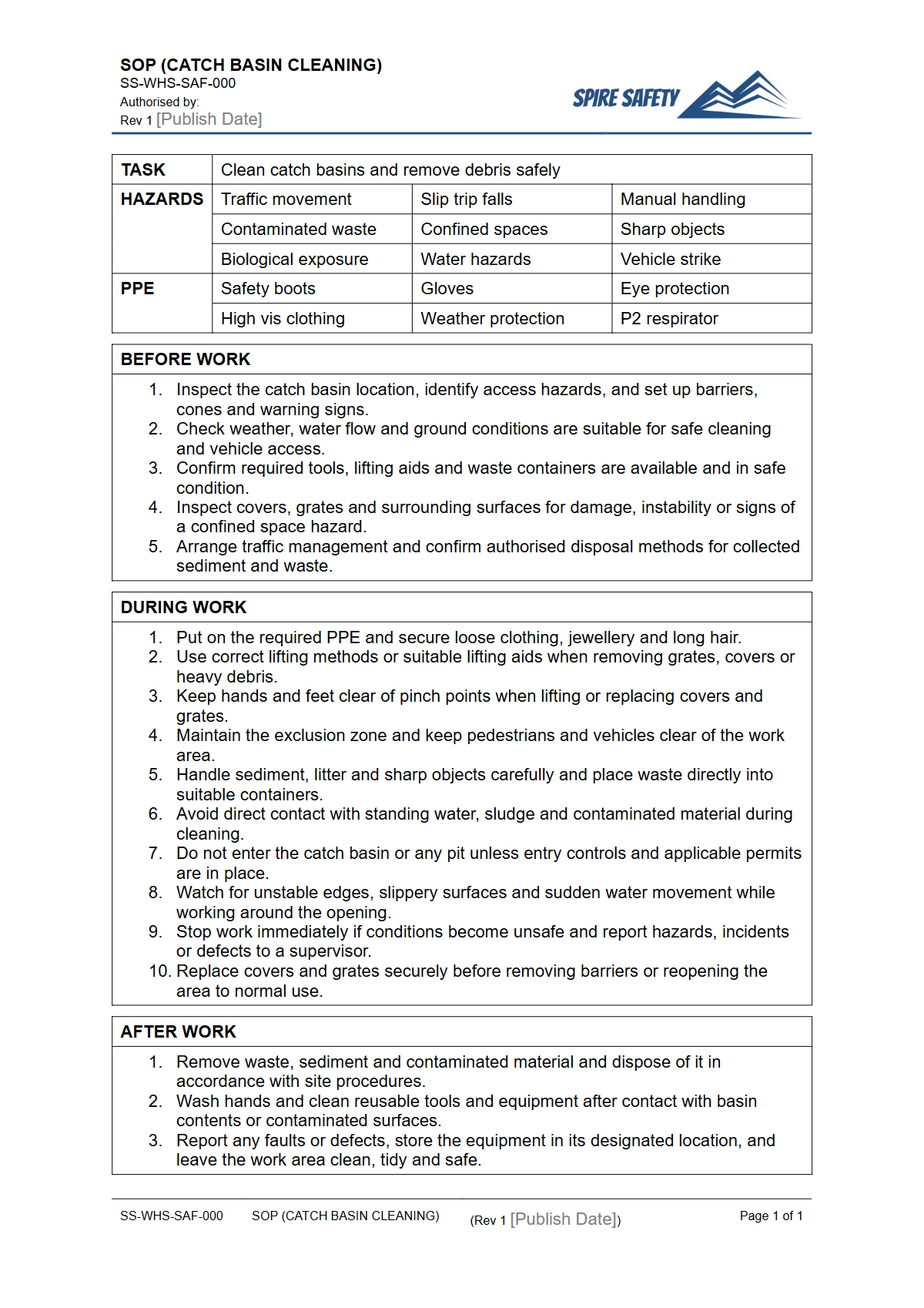
Purpose of the Free Safe Operating Procedure (Catch Basin Cleaning) Template
Effectively managing stormwater infrastructure is crucial for site safety and environmental compliance. Our free Safe Operating Procedure (Catch Basin Cleaning) Template provides a structured starting point for documenting the risks and control measures associated with this common but hazardous task.
This SOP helps your organisation detail a step-by-step process for cleaning catch basins (also known as storm drains or gully pits), addressing hazards like confined spaces, hazardous manual tasks, traffic interaction, and exposure to biological or chemical contaminants.
Using a standardised procedure ensures that all workers follow a consistent, safe method, reducing the likelihood of incidents and injuries. This document serves as an essential tool for training, task planning, and demonstrating due diligence in managing workplace health and safety risks.
For tasks involving other specialised ground-engaging equipment, our FREE Trencher SOP Template provides a similarly structured approach to managing specific machinery risks.
Video walkthrough
How to use the Free Safe Operating Procedure (Catch Basin Cleaning) Template
This resource is available for download as both a DOCX file for easy editing and a PDF for reference. We recommend using the DOCX version to adapt the content to your specific operational context.
A generic procedure is not sufficient for compliance; it must reflect the reality of your worksite.
Please note: This is a template only. We have not been to your workplace, so you MUST customise this document by adding site-specific details, equipment models, and control measures relevant to your operations.
Integrate this customised SOP into your broader safety framework to ensure it is implemented effectively. A well-documented procedure is a cornerstone of robust WHS management systems, connecting policy with practice and ensuring safety protocols are clearly communicated and consistently applied.
Key elements to customise:
- Personal Protective Equipment (PPE): Specify the exact type of gloves, eyewear, respiratory protection, and high-visibility clothing required.
- Tools and Equipment: List the specific vacuum trucks, jetting units, hand tools, and lifting devices used by your team.
- Emergency Procedures: Detail your site's specific response plan for incidents like gas exposure, injury, or spills.
- Site-Specific Hazards: Include details about traffic conditions, overhead powerlines, or unique basin configurations at your location.
- Waste Disposal: Outline the approved method for transporting and disposing of collected sludge and debris in accordance with local environmental regulations.
When to use a Catch Basin Cleaning SOP
This Safe Operating Procedure should be used as a primary reference document for all activities related to catch basin cleaning. It is a critical resource for training new workers and for conducting refresher training for experienced personnel.
Supervisors should use it to conduct pre-start toolbox talks before commencing work, ensuring every team member understands the risks and controls for the day's specific task. The SOP is also a valuable reference during job planning and risk assessment phases. On large civil sites, this procedure must be coordinated with other activities, such as those involving earthmoving plant detailed in our FREE Dozer SOP Template.
Who should use this SOP Template
This template is designed for any Person Conducting a Business or Undertaking (PCBU) whose workers perform catch basin cleaning. This includes companies in civil construction, plumbing, drainage services, facilities management, and local government operations.
- Managers and Supervisors: To implement and enforce safe work practices, provide training, and ensure resources are available for safe task execution.
- WHS Professionals: To integrate the procedure into the overall safety management system and use it as a basis for risk assessments and incident investigations.
- Workers: To understand and follow the required safety steps, use equipment correctly, and identify and report hazards.
Periodic review of how well the SOP is being followed in practice is essential for maintaining safety standards. These practical checks can form part of a scheduled WHS compliance auditing program to verify that documented procedures align with on-the-ground activities.
Common mistakes
Common mistakes to avoid
- Underestimating the risks of a confined space and failing to conduct atmospheric testing.
- Using inadequate or poorly maintained equipment, such as faulty vacuum hoses or pumps.
- Implementing poor traffic management, creating a risk of collision between workers and vehicles.
- Incorrectly disposing of collected waste, leading to environmental fines and clean-up costs.
Legal references
Legal considerations
The following legal requirements may be relevant to this type of work.
- Work Health and Safety Act (Harmonised) — Provides the primary duties for protecting workers and other people from work health and safety risks.
- Work Health and Safety Regulations (Harmonised) — Sets out requirements supporting the management of workplace hazards and risks.
The following codes may be relevant to this type of work.
- Managing WHS Risks Code of Practice — Provides practical guidance on identifying hazards, assessing risks and applying effective controls.
- Work Health and Safety Consultation, Cooperation and Coordination Code of Practice — Provides practical guidance on consulting workers and coordinating with other duty holders.
- Managing the Work Environment and Facilities Code of Practice — Provides practical guidance on safe work environments, workplace facilities and related controls.
Did you know
Confined Space Risk
Many catch basins and storm drains are legally defined as confined spaces. This means entry is prohibited without specific risk assessments, permits, atmospheric testing, and rescue plans in place.
Pollutant Traps
Catch basins are designed to trap sediment, debris, and pollutants from stormwater runoff. A single uncleaned basin can release significant amounts of contaminants like heavy metals and hydrocarbons into local waterways during a heavy rain event.
FAQ
Frequently asked questions
01What are the main hazards of catch basin cleaning?
02How often should a catch basin cleaning SOP be reviewed?
03Is a Safe Work Method Statement (SWMS) required for catch basin cleaning?
04What personal protective equipment (PPE) is needed for cleaning catch basins?
Share this resource
Free Safe Operating Procedure (Catch Basin Cleaning) Template
Browse Categories
How To Use It
- 1Download and open in Word or PDF.
- 2Replace the placeholders with your business details.
- 3Get it reviewed by a WHS specialist before rollout.
Need it customised?
Our WHS consultants can adapt this template to your site, run a gap analysis, or audit what you already have in place.
Book a Free Consultation WHS consulting servicesor call 1300 156 382
Related templates
- Free Safe Operating Procedure (Catch Basin Inspection) Template
- Free Safe Operating Procedure (Catering Cart Handling) Template
- Free Safe Operating Procedure (Cattle Drafting) Template
- Free Safe Operating Procedure (Cattle Feeding) Template
- Free Safe Operating Procedure (Cattle Footbath) Template
- Free Safe Operating Procedure (Cattle Loading Ramp) Template