
Free Safe Operating Procedure (Cash Transit Handover) Template
Download our free Safe Operating Procedure (Cash Transit Handover) Template. This Word & PDF resource provides a structured starting point for your business.
Free Safe Operating Procedure (Cash Transit Handover) Template
DOCX • 126 KB + PDF
Updated Oct 2026
No signup required
Purpose of the Free Safe Operating Procedure (Cash Transit Handover) Template
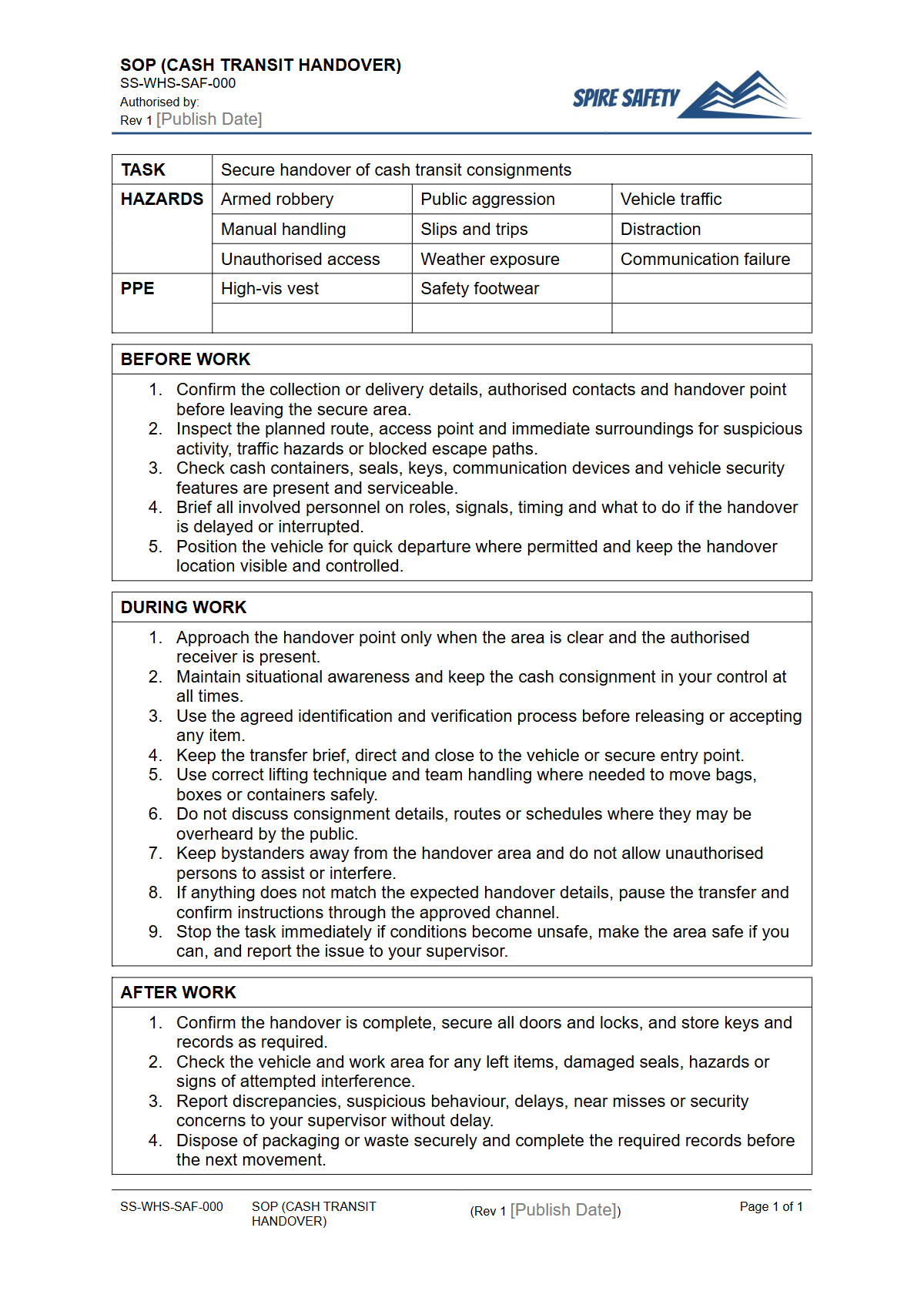
Managing the transfer of cash from your premises to a bank or cash-in-transit (CIT) service provider is a high-risk activity. This free Safe Operating Procedure (Cash Transit Handover) template provides a clear framework for establishing a standardised, safe process.
A documented SOP is crucial for minimising the risks of robbery, assault, and financial loss. It helps ensure every team member understands their role and the required safety precautions, forming a critical part of your overall safety management approach.
By implementing a formal procedure, you can train staff effectively, reduce procedural errors, and demonstrate due diligence in managing workplace risks. This document is designed as a starting point, aligned with Australian WHS principles, to help you formalise your cash handling protocols.
Properly implemented SOPs are a cornerstone of effective WHS management systems, providing consistency and control over hazardous tasks.
Video walkthrough
How to use the Free Safe Operating Procedure (Cash Transit Handover) Template
This Safe Operating Procedure for cash transit handover is provided as a fully editable DOCX file, with a PDF version also available for easy printing and distribution. To use it, simply download the template and open it in your preferred word processor.
You will need to carefully review each section and adapt the content to match your specific operational environment. This includes detailing your site layout, specific personnel roles, cash limits, emergency contacts, and the exact steps for your handover process.
IMPORTANT: This is a template only. We have provided a solid foundation, but you must adapt it to the specific risks, layout, personnel, and procedures of your workplace.
A generic procedure is not sufficient; customisation is essential for the SOP to be effective and to meet your safety obligations. Generic procedures can fail to account for site-specific hazards, leading to dangerous gaps in your safety process.
When to use it
This SOP should be used whenever cash takings are prepared for and handed over to an external party for transport off-site. It is primarily designed for businesses in sectors like retail, hospitality, entertainment, and any other organisation that handles regular cash transactions.
The procedure should be followed for routine end-of-day bank deposits, end-of-shift clearances, and scheduled pickups by professional CIT services. Using a documented process ensures consistency, which is vital for security.
The principles in this SOP are also relevant for internal cash movements, though the specific steps may differ. Whether the transit is performed by an employee or a third-party guard using an armoured vehicle, having a clear procedure is key.
For tasks involving vehicles, a separate procedure like our FREE Body Truck SOP (Safe Operating Procedure) Template may also be necessary to cover vehicle-specific hazards.
Who should use it
This template is intended for business owners, venue managers, supervisors, and WHS professionals responsible for creating and implementing safety procedures. It provides the structure needed to develop a robust process.
Once customised, the resulting SOP should be used by all employees involved in the cash handover process. This typically includes duty managers, accounts staff, security personnel, and any other team members authorised to handle, count, or transfer cash.
Regular training on the finalised SOP is vital for all relevant staff. Competency should be verified, and the procedure's effectiveness should be periodically checked.
A formal review process, potentially as part of a scheduled WHS compliance audit, ensures the procedure remains current and effective against evolving risks. You can find many other useful templates in our free WHS resources library to support your safety framework.
Even seemingly simple tasks at a workplace can carry significant risk if not managed correctly. Implementing SOPs for a wide range of activities establishes a strong safety culture.
For example, having a FREE Step Ladder SOP (Safe Operating Procedure) Template ensures that even common equipment is used safely and consistently, reinforcing the importance of procedure for all tasks, big or small.
Common mistakes
Common mistakes to avoid
- Becoming complacent and not varying handover times, routes, or personnel.
- Conducting the handover in a public or highly visible area instead of a secure, designated room.
- Failing to provide comprehensive training to staff on the procedure and emergency actions.
- Not reviewing or updating the SOP after a near-miss or a change in business operations.
Legal references
Legal considerations
The following legal requirements may be relevant to this type of work.
- Work Health and Safety Act (Harmonised) — Provides the primary duties for protecting workers and other people from work health and safety risks.
- Work Health and Safety Regulations (Harmonised) — Sets out requirements supporting the management of workplace hazards and risks.
The following codes may be relevant to this type of work.
- Managing WHS Risks Code of Practice — Provides practical guidance on identifying hazards, assessing risks and applying effective controls.
- Work Health and Safety Consultation, Cooperation and Coordination Code of Practice — Provides practical guidance on consulting workers and coordinating with other duty holders.
- Managing the Work Environment and Facilities Code of Practice — Provides practical guidance on safe work environments, workplace facilities and related controls.
Did you know
Predictability is the Enemy
One of the biggest risk factors for cash-related robberies is predictability. Businesses that use the same staff member, at the same time, following the same route to the bank are at a significantly higher risk.
Deterrence Works
Visible security measures, such as cameras, clear signage about security procedures, and the presence of uniformed guards, act as powerful deterrents. The goal is often to make your business a harder target than others nearby.
FAQ
Frequently asked questions
01What is the difference between an SOP and a SWMS for cash handling?
02How often should our cash transit SOP be reviewed?
03What are the most critical elements of a safe cash handover procedure?
04Do my staff need specific training to handle cash transfers?
Share this resource
Free Safe Operating Procedure (Cash Transit Handover) Template
Browse Categories
How To Use It
- 1Download and open in Word or PDF.
- 2Replace the placeholders with your business details.
- 3Get it reviewed by a WHS specialist before rollout.
Need it customised?
Our WHS consultants can adapt this template to your site, run a gap analysis, or audit what you already have in place.
Book a Free Consultation WHS consulting servicesor call 1300 156 382
Related templates
- Free Safe Operating Procedure (Cask Handling) Template
- Free Safe Operating Procedure (Casket Handling) Template
- Free Safe Operating Procedure (Catch Basin Cleaning) Template
- Free Safe Operating Procedure (Catch Basin Inspection) Template
- Free Safe Operating Procedure (Catering Cart Handling) Template
- Free Safe Operating Procedure (Cattle Drafting) Template