
Free Safe Operating Procedure (Cash Safe Access) Template
Download our free Safe Operating Procedure (Cash Safe Access) template.
Free Safe Operating Procedure (Cash Safe Access) Template
DOCX • 126 KB + PDF
Updated Oct 2026
No signup required
Purpose of the Free Safe Operating Procedure (Cash Safe Access) Template
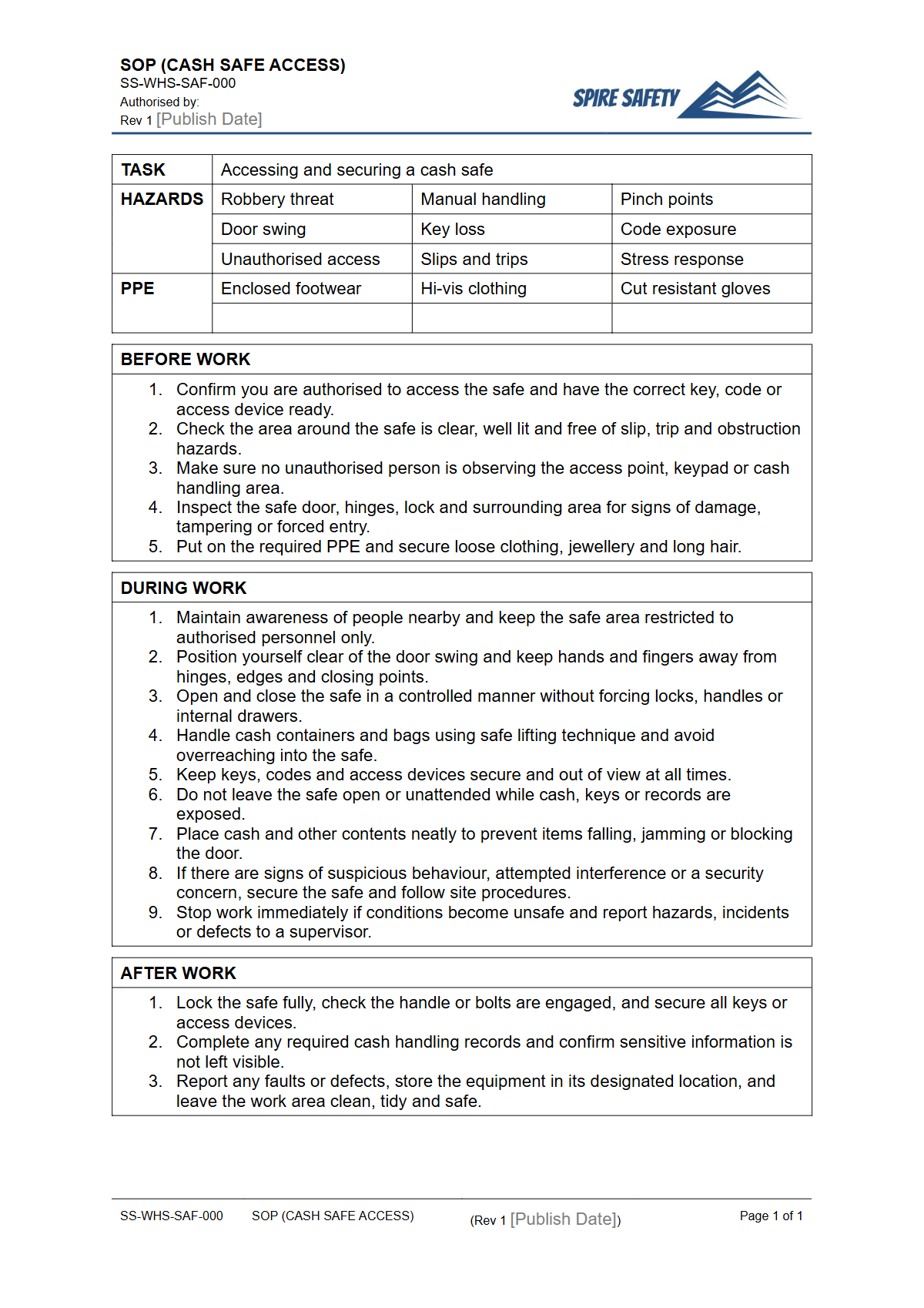
Managing cash securely is a critical task for many Australian businesses, involving significant risks that go beyond simple financial loss. Developing a clear process is crucial, and this free Safe Operating Procedure (Cash Safe Access) template provides a structured starting point.
The primary purpose of this SOP is to outline a standardised, safe method for employees to access, handle, and secure cash within a workplace safe. It aims to minimise risks such as robbery, theft, and assault by establishing clear, sequential steps and responsibilities.
By implementing a formal procedure, an organisation demonstrates its commitment to worker safety and security. This document helps control identified hazards associated with cash handling, such as working alone, unpredictable public interactions, and the psychological stress of being responsible for large sums of money.
A well-defined SOP is a fundamental component of an effective safety management system, ensuring that all tasks are performed consistently and safely by all trained personnel. It serves as both a training tool for new employees and a reference guide for experienced staff, reinforcing safe work habits and emergency protocols.
What this Safe Operating Procedure covers:
- Essential personal protective equipment (PPE) requirements, if applicable.
- A step-by-step guide to accessing the safe, counting cash, and securing it.
- Pre-operational checks and post-task clean-up procedures.
- Key safety considerations and risk control measures.
- Training and competency requirements for authorised personnel.
Video walkthrough
How to use the Free Safe Operating Procedure (Cash Safe Access) Template
This Safe Operating Procedure (Cash Safe Access) template is provided in both DOCX and PDF formats for your convenience. The DOCX file is fully editable, allowing you to tailor the content to the specific equipment, environment, and processes of your workplace.
It's crucial to adapt this document to reflect your unique operational risks and control measures. The principles of creating a clear, sequential SOP are universal, whether you are documenting cash handling or a physical task; you can see a similar structure in our free Step Ladder SOP template.
To effectively use this template, begin by conducting a thorough risk assessment of your cash handling processes. Identify all potential hazards, from the location of the safe to the time of day cash is handled.
Use the findings to add, remove, or modify the steps and safety precautions outlined in the document. Ensure that the procedure clearly specifies who is authorised to perform the task, the maximum amount of cash to be held (float limits), and the precise steps for opening, clearing, and locking the safe. The goal is to break down the task into manageable parts, a method used in all our procedural documents, from this cash handling guide to our FREE Body Truck SOP Template.
Important: This is a template only. It must be customised to suit the specific circumstances of your workplace.
We are not responsible for the outcomes if you use this template without tailoring it to your business's individual needs. We highly recommend consulting with safety professionals to ensure your final document is robust and effective.
When to use a Cash Safe Access SOP
A Safe Operating Procedure for cash safe access should be used every time an authorised employee needs to perform tasks involving the workplace safe. This includes routine activities such as setting up cash floats at the beginning of a shift, clearing registers, consolidating takings, and preparing bank deposits.
Its use should be mandatory, not optional, to ensure consistent application of safety protocols.
The SOP is particularly important during periods of heightened risk, such as opening and closing times when the premises may be quieter or have fewer staff present. It also serves as a critical guide for actions to be taken in the event of an emergency, like a robbery or attempted theft.
Regular reviews and updates to the SOP are essential, especially after any incident, near miss, or change in business operations. Incorporating these reviews into a schedule of WHS compliance auditing ensures procedures remain relevant and effective.
Who should use this Safe Operating Procedure
This SOP is intended for all personnel who are authorised to handle cash and access the safe. This typically includes managers, supervisors, and designated cashiers or administration staff.
Every employee with this responsibility must be thoroughly trained on the procedure before they are permitted to perform the task independently. Training should cover not only the step-by-step process but also the reasoning behind each safety measure and the appropriate response to emergency situations.
Supervisors and managers have a broader responsibility to ensure the SOP is implemented correctly, that staff are following it, and that any deviations are addressed promptly. They are also responsible for conducting periodic reviews of the procedure and ensuring all relevant personnel receive refresher training.
For managers overseeing diverse operational risks, it's useful to understand how SOPs function across different areas. They can find additional examples, such as our Free Air Compressor SOP, in our extensive free WHS resources library. Ultimately, a robust SOP is a key element in building comprehensive WHS management systems that protect workers from all foreseeable workplace hazards.
Common mistakes
Common mistakes to avoid
- Failing to restrict and audit safe access, leaving it open to unauthorised personnel.
- Becoming complacent and not varying routines for cash clearances and bank deposits.
- Performing cash handling tasks alone, especially at night or in isolated areas of the business.
- Neglecting to provide practical training on how to respond calmly and safely during a robbery.
Legal references
Legal considerations
The following legal requirements may be relevant to this type of work.
- Work Health and Safety Act (Harmonised) — Provides the primary duties for protecting workers and other people from work health and safety risks.
- Work Health and Safety Regulations (Harmonised) — Sets out requirements supporting the management of workplace hazards and risks.
The following codes may be relevant to this type of work.
- Managing WHS Risks Code of Practice — Provides practical guidance on identifying hazards, assessing risks and applying effective controls.
- Work Health and Safety Consultation, Cooperation and Coordination Code of Practice — Provides practical guidance on consulting workers and coordinating with other duty holders.
- Managing the Work Environment and Facilities Code of Practice — Provides practical guidance on safe work environments, workplace facilities and related controls.
Did you know
Robbery Risks
According to the Australian Institute of Criminology, retail businesses are one of the most common targets for robbery, with incidents often occurring during opening or closing hours when fewer staff and customers are present.
FAQ
Frequently asked questions
01What are the main risks associated with accessing a cash safe?
02How often should a Safe Operating Procedure for cash handling be reviewed?
03Who needs to be trained on the cash safe access SOP?
04Can this SOP template be used for cash-in-transit procedures?
Share this resource
Free Safe Operating Procedure (Cash Safe Access) Template
Browse Categories
How To Use It
- 1Download and open in Word or PDF.
- 2Replace the placeholders with your business details.
- 3Get it reviewed by a WHS specialist before rollout.
Need it customised?
Our WHS consultants can adapt this template to your site, run a gap analysis, or audit what you already have in place.
Book a Free Consultation WHS consulting servicesor call 1300 156 382
Related templates
- Free Safe Operating Procedure (Cash Transit Handover) Template
- Free Safe Operating Procedure (Cask Handling) Template
- Free Safe Operating Procedure (Casket Handling) Template
- Free Safe Operating Procedure (Catch Basin Cleaning) Template
- Free Safe Operating Procedure (Catch Basin Inspection) Template
- Free Safe Operating Procedure (Catering Cart Handling) Template