
Free Safe Operating Procedure (Abrasive Cutoff Saw) Template
Download our free Safe Operating Procedure (Abrasive Cutoff Saw) Template.
Free Safe Operating Procedure (Abrasive Cutoff Saw) Template
DOCX • 126 KB + PDF
Updated Oct 2026
No signup required
Purpose of the Free Safe Operating Procedure (Abrasive Cutoff Saw) Template
An abrasive cutoff saw, also known as a drop saw or chop saw, is a powerful tool essential in many metal fabrication and construction workshops. However, its operation presents significant risks, including severe cuts, entanglement, fire from sparks, and exposure to harmful dust and noise.
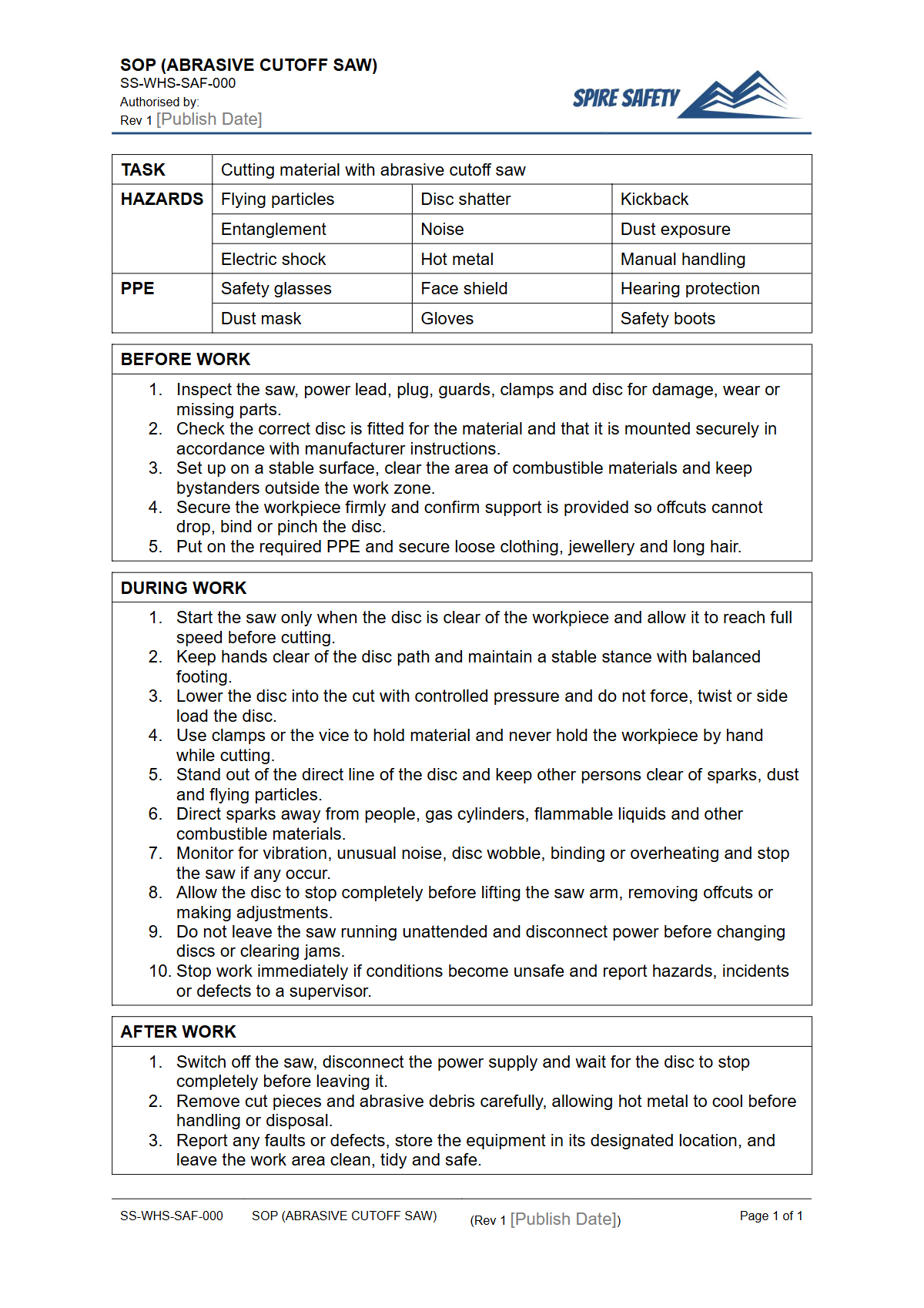
This Free Safe Operating Procedure (Abrasive Cutoff Saw) Template provides a structured framework for documenting the safest way to use this equipment in your workplace.
A documented SOP is a fundamental control measure that helps standardise work practices, ensuring every operator follows a consistent, pre-approved method. It serves as a vital training tool and a reference point for supervisors, helping your organisation meet its duty of care under Australian WHS legislation.
Using a clear SOP helps minimise the risk of injury and demonstrates a commitment to a safe working environment. The principles of documenting safe work methods are similar across various cutting equipment, as seen in our plasma cutter SOP.
Key Hazards Addressed
This template prompts you to consider and control common hazards associated with abrasive cutoff saws, such as:
- Contact with the rotating abrasive wheel.
- Sparks igniting flammable materials.
- Kickback from incorrect use or wheel binding.
- Airborne particles (dust and metal fumes) requiring respiratory protection.
- Noise exposure leading to hearing damage.
- Blade failure or shattering.
- Electric shock from faulty equipment.
Video walkthrough
How to use the Free Safe Operating Procedure (Abrasive Cutoff Saw) Template
This Safe Operating Procedure for an abrasive cutoff saw is provided in both DOCX and PDF formats for your convenience. The DOCX file is fully editable, allowing you to adapt the content to the specific make and model of the saw used in your workplace, as well as your unique operational context and risk profile.
Important: This document is a template, not a finished procedure. To be effective, you must customise it by conducting a site-specific risk assessment and consulting with the workers who operate the equipment.
We have pre-filled common steps and hazards, but it is your responsibility to ensure the final document is accurate and reflects the reality of your workshop. Integrating such procedures is a core component of developing robust WHS management systems.
When to use an Abrasive Cutoff Saw SOP
A Safe Operating Procedure for an abrasive cutoff saw should be readily available and referenced at all times. It is not a document to be filed away and forgotten. Specifically, it should be used:
- During operator training: As a primary document for training new or inexperienced workers.
- For pre-start checks: To guide operators through essential safety inspections before each use.
- As an on-the-job reference: For operators to confirm correct procedures, especially for non-routine tasks.
- During safety audits and reviews: To assess whether prescribed safety practices are being followed.
- After an incident or near-miss: To review and improve procedures to prevent recurrence.
The consistent application of an SOP is crucial for maintaining safety standards. This is true for all power tools, and you can see a similar structure in our circular saw SOP, which addresses related cutting hazards.
Who should use this Safe Operating Procedure
This SOP is intended for several key roles within a workplace:
- Operators: The primary users, who must be trained on the contents of the SOP and declared competent before being authorised to use the abrasive cutoff saw.
- Supervisors and Line Managers: To monitor compliance, enforce safe work practices, and provide guidance to their teams.
- WHS Managers and Safety Officers: To develop, implement, and review safety documentation as part of the overall safety management system.
- Persons Conducting a Business or Undertaking (PCBUs): To ensure they are providing the necessary information, training, and instruction to protect workers from harm.
Ultimately, anyone involved in the lifecycle of using the equipment—from procurement and installation to operation and maintenance—should be familiar with the SOP. The detail required can vary by equipment type, from simple hand tools to complex machinery like that covered in our waterjet cutter SOP. If your organisation needs help tailoring these documents or assessing overall workshop risks, our WHS consulting services can provide expert guidance.
Common mistakes
Common mistakes to avoid
- Failing to properly secure the workpiece in the vice before starting a cut.
- Applying excessive downward force, which can lead to motor strain, kickback, or wheel damage.
- Using a wheel that is cracked, chipped, or past its expiry date.
- Standing directly in line with the cutting wheel, which is the highest-risk zone for injury from kickback or wheel failure.
Legal references
Legal considerations
The following legal requirements may be relevant to this type of work.
- Work Health and Safety Act (Harmonised) — Provides the primary duties for protecting workers and other people from work health and safety risks.
- Work Health and Safety Regulations (Harmonised) — Sets out requirements supporting the management of workplace hazards and risks.
The following codes may be relevant to this type of work.
- Managing WHS Risks Code of Practice — Provides practical guidance on identifying hazards, assessing risks and applying effective controls.
- Work Health and Safety Consultation, Cooperation and Coordination Code of Practice — Provides practical guidance on consulting workers and coordinating with other duty holders.
- Managing the Work Environment and Facilities Code of Practice — Provides practical guidance on safe work environments, workplace facilities and related controls.
Did you know
Wheel Speed is Critical
Every abrasive wheel is rated for a maximum RPM. Using a wheel on a saw that exceeds this speed can cause it to disintegrate violently, ejecting sharp fragments at high velocity.
Types of Wheels
Abrasive cutoff wheels are consumables designed to wear down as they cut. They differ from toothed saw blades, and it's vital to select a wheel specifically designed for the material being cut (e.g., steel, aluminium).
FAQ
Frequently asked questions
01What should be included in an abrasive cutoff saw SOP?
02Is an SOP a legal requirement for abrasive saws in Australia?
03How often should an abrasive cutoff saw SOP be reviewed?
04Who is responsible for writing the abrasive saw SOP?
Share this resource
Free Safe Operating Procedure (Abrasive Cutoff Saw) Template
Browse Categories
How To Use It
- 1Download and open in Word or PDF.
- 2Replace the placeholders with your business details.
- 3Get it reviewed by a WHS specialist before rollout.
Need it customised?
Our WHS consultants can adapt this template to your site, run a gap analysis, or audit what you already have in place.
Book a Free Consultation WHS consulting servicesor call 1300 156 382
Related templates
- Free Safe Operating Procedure (Absorbent Cleanup) Template
- Free Safe Operating Procedure (AC Refrigerant Recovery) Template
- Free Safe Operating Procedure (AC Vacuum Pump) Template
- Free Safe Operating Procedure (Access Control Panel) Template
- Free Safe Operating Procedure (Access Hatch Inspection) Template
- Free Safe Operating Procedure (Accessible Bus Loading) Template