
Free Safe Operating Procedure (Carton Erector) Template
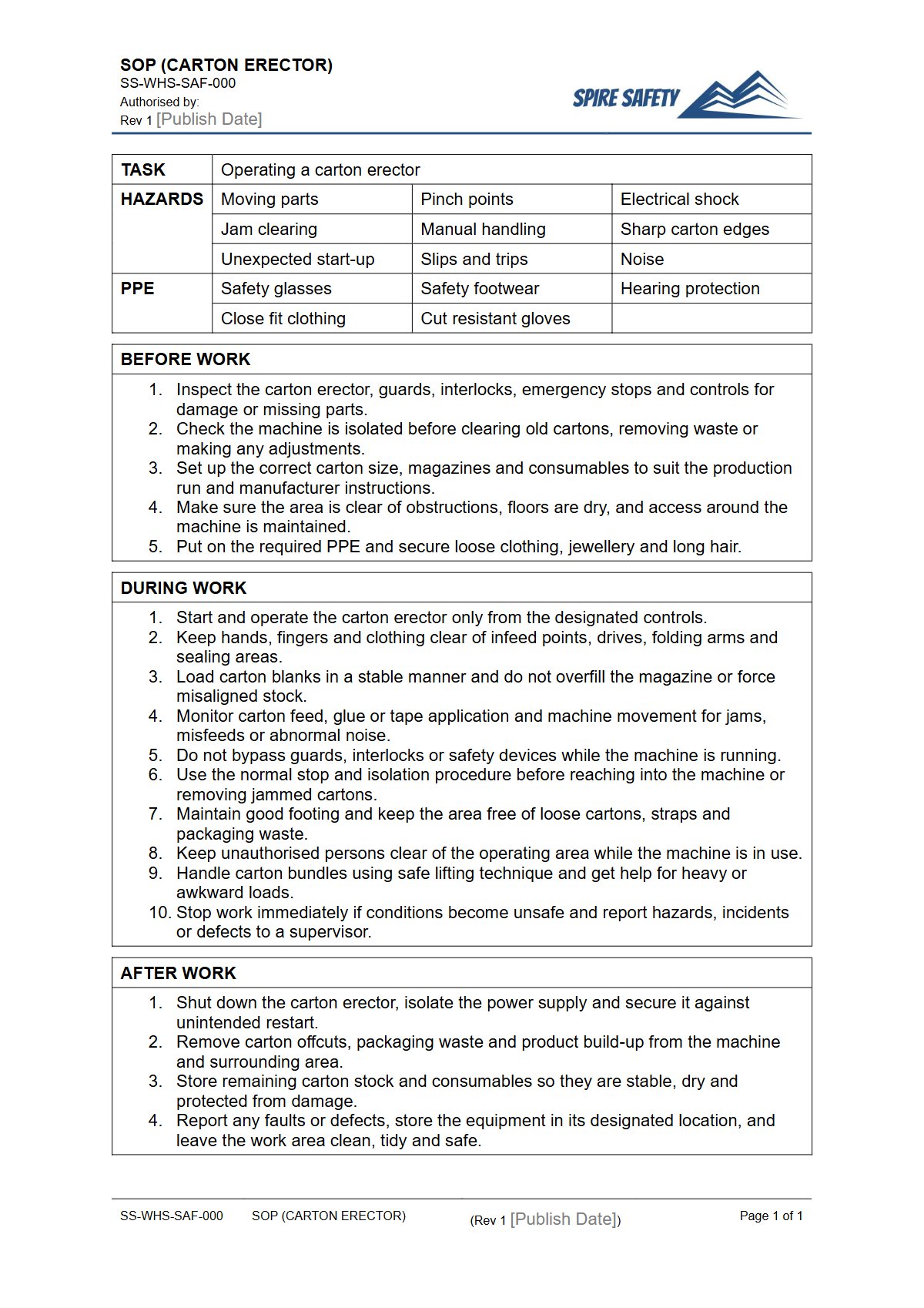
Download our free Safe Operating Procedure (Carton Erector) template. This user-friendly DOCX and PDF resource helps you outline safe work practices.
Free Safe Operating Procedure (Carton Erector) Template
DOCX • 126 KB + PDF
Updated Oct 2026
No signup required
Purpose of the Free Safe Operating Procedure (Carton Erector) Template
This Free Safe Operating Procedure (Carton Erector) Template provides a structured starting point for documenting the risks and controls associated with automatic or semi-automatic carton forming machines. Carton erectors improve efficiency but also introduce hazards such as moving parts, pinch points, and noise.
A documented SOP is a critical tool for ensuring all operators follow a consistent, safe method of work, minimising the risk of injury.
A well-drafted SOP is a fundamental component of a proactive safety culture and is essential for organisations committed to developing a comprehensive WHS management system. This template is designed to help you meet your duty of care by formalising procedures and demonstrating a systematic approach to managing plant safety in your workplace.
Video walkthrough
How to use the Free Safe Operating Procedure (Carton Erector) Template
Our template is provided in both DOCX and PDF formats for your convenience. The DOCX file is fully editable, allowing you to tailor the content to the specific make, model, and configuration of the carton erector used in your facility.
It guides you through documenting key safety elements including required PPE, pre-operational checks, step-by-step operating instructions, and procedures for clearing jams and performing routine maintenance.
Important: This is a template, not a finished document. You must customise it with details specific to your workplace, equipment, and processes.
We strongly recommend consulting with the machine operators and maintenance personnel when customising the SOP to ensure it is practical and reflects actual work practices. Many carton erectors are pneumatically powered, so you may also find our free Air Compressor SOP useful for documenting related procedures.
When to use a Safe Operating Procedure
A Safe Operating Procedure for a carton erector should be used in several key situations. It serves as a primary training document for new operators, ensuring they learn the correct, safe method from the outset.
It is also an essential tool for refresher training and for verifying competency on an ongoing basis.
Furthermore, the SOP should be readily available at or near the machine as a quick reference for operators. It is also a vital piece of evidence during safety reviews and can be referenced when conducting a risk assessment or investigating an incident or near miss. Having a current, accurate SOP is a key item that would be checked as part of a WHS compliance audit.
Who should use this Safe Operating Procedure
This SOP is intended for use by several key roles within an organisation. Primarily, it is for the equipment operators who use the carton erector daily.
They must be trained on its contents and be able to follow the specified procedures every time.
Supervisors and team leaders are responsible for ensuring operators adhere to the SOP and for conducting regular checks. Maintenance personnel should also use the SOP, particularly sections related to lockout/tagout (LOTO) procedures, troubleshooting, and safe maintenance access.
For tasks requiring access to elevated parts of the machine, procedures from other documents like a free Step Ladder SOP may also need to be followed.
Integrating SOPs into Your Workflow
Once cartons are erected and packed, they are typically moved for shipping. Integrating your plant SOPs with logistics procedures creates a seamless and safe workflow from production to dispatch.
For example, the output of this process may directly lead into the tasks covered by a free Body Truck SOP, ensuring safety is maintained throughout the supply chain.
This template is just one of many tools available to help you build a safer workplace. We encourage you to explore our complete free WHS resources library for more templates, checklists, and guides to support your safety management efforts.
Common mistakes
Common mistakes to avoid
- Using a generic template without customising it for the specific machine and workplace.
- Failing to involve the actual operators and maintenance staff in the drafting and review process.
- Not providing adequate training on the SOP's contents, making it just a 'tick-box' document.
- Forgetting to review and update the SOP after an incident or when a process changes.
Legal references
Legal considerations
The following legal requirements may be relevant to this type of work.
- Work Health and Safety Act (Harmonised) — Provides the primary duties for protecting workers and other people from work health and safety risks.
- Work Health and Safety Regulations (Harmonised) — Sets out requirements supporting the management of workplace hazards and risks.
The following codes may be relevant to this type of work.
- Managing WHS Risks Code of Practice — Provides practical guidance on identifying hazards, assessing risks and applying effective controls.
- Work Health and Safety Consultation, Cooperation and Coordination Code of Practice — Provides practical guidance on consulting workers and coordinating with other duty holders.
- Managing the Work Environment and Facilities Code of Practice — Provides practical guidance on safe work environments, workplace facilities and related controls.
Did you know
Machine Guarding
According to Safe Work Australia, inadequate machine guarding is a leading cause of serious workplace injuries. An SOP reinforces the importance of keeping all guards in place and implementing proper lockout/tagout procedures during maintenance.
FAQ
Frequently asked questions
01What are the main hazards of a carton erector machine?
02Is a Safe Operating Procedure legally required for a carton erector in Australia?
03Who is responsible for writing a Carton Erector SOP?
04How often should an SOP for a carton erector be reviewed?
Share this resource
Free Safe Operating Procedure (Carton Erector) Template
Browse Categories
How To Use It
- 1Download and open in Word or PDF.
- 2Replace the placeholders with your business details.
- 3Get it reviewed by a WHS specialist before rollout.
Need it customised?
Our WHS consultants can adapt this template to your site, run a gap analysis, or audit what you already have in place.
Book a Free Consultation WHS consulting servicesor call 1300 156 382
Related templates
- Free Safe Operating Procedure (Carton Sealer) Template
- Free Safe Operating Procedure (Case Packer) Template
- Free Safe Operating Procedure (Cash Counting) Template
- Free Safe Operating Procedure (Cash Drawer Handling) Template
- Free Safe Operating Procedure (Cash Safe Access) Template
- Free Safe Operating Procedure (Cash Transit Handover) Template