
Free Safe Operating Procedure (Case Packer) Template
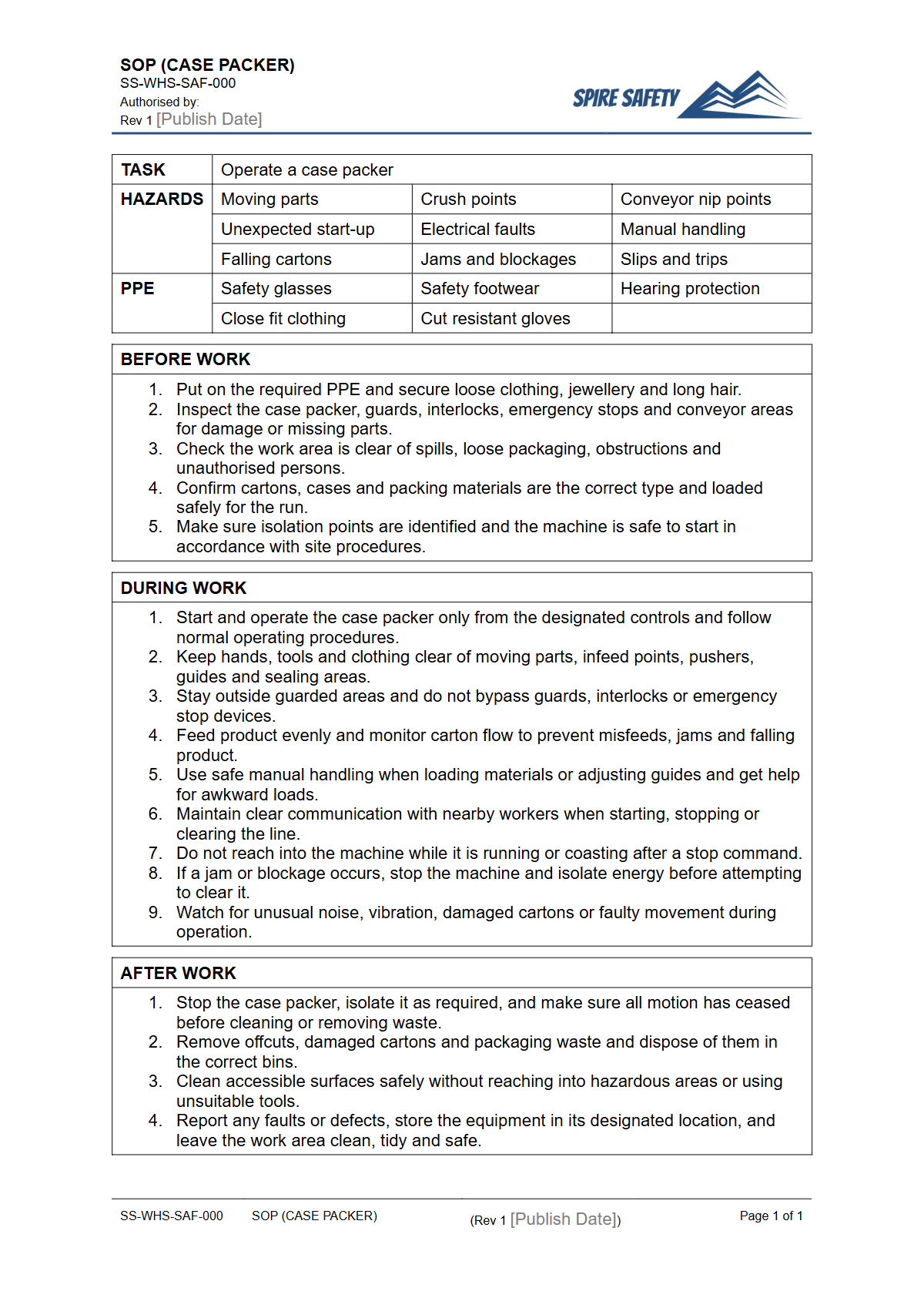
Download our free Safe Operating Procedure (Case Packer) template. This user-friendly DOCX and PDF provides a structured guide for safe case packer operation.
Free Safe Operating Procedure (Case Packer) Template
DOCX • 126 KB + PDF
Updated Oct 2026
No signup required
Purpose of the Free Safe Operating Procedure (Case Packer) Template
Operating industrial machinery like case packers introduces significant workplace hazards, including entanglement, crushing, and manual handling injuries. The purpose of this Free Safe Operating Procedure (Case Packer) Template is to provide a structured document that helps your organisation outline and standardise the safe method for using this equipment.
By clearly defining pre-start checks, step-by-step instructions, and emergency protocols, an SOP helps minimise operator error and ensures everyone follows a consistent, safe process.
Implementing documented procedures is a critical component of risk management. A well-developed SOP serves as an essential training tool for new employees, a refresher for experienced operators, and a key piece of evidence demonstrating your commitment to safety.
An effective SOP is a cornerstone of robust WHS management systems, demonstrating a proactive approach to safety.
Video walkthrough
How to use the Free Safe Operating Procedure (Case Packer) Template
This SOP template is designed for ease of use. After downloading the DOCX file, you can open it in Microsoft Word or any compatible word processor.
The document is structured with clear headings and prompts, guiding you to fill in the specific details relevant to your workplace.
Important: This is a template document we have created to serve as a starting point. You must customise it with your specific site, machinery models, materials, and procedural details to ensure it is relevant and effective for your workplace.
A generic procedure that doesn't reflect your actual operations will not be effective in controlling risks. While this SOP focuses on case packers, you may also need procedures for other equipment, such as our Free Brake Press SOP.
Key Sections to Customise
- Plant and Equipment Details: List the specific make, model, and any unique identifiers for your case packer(s).
- Personal Protective Equipment (PPE): Specify the mandatory PPE required for operators, such as safety glasses, gloves, or steel-capped boots.
- Pre-Operational Checks: Detail the daily or pre-start inspections operators must perform. This should include checking machine guarding, emergency stops, sensors, and the general work area.
- Step-by-Step Operating Instructions: This is the core of the SOP. Document every step from machine start-up, loading materials, normal operation, clearing minor jams, and standard shutdown. Be clear and concise.
- Emergency Procedures: Outline the exact steps to take in an emergency, including how to activate the emergency stop, isolation procedures, and who to contact.
When to use a Case Packer SOP
A Safe Operating Procedure for a case packer should be an active document integrated into your daily operations, not just a file stored on a server. It is most effective when used for:
- Induction and Training: Provide the SOP to all new operators as a core part of their initial training.
- Refresher Training: Use the document for periodic refresher sessions to prevent procedural drift and reinforce safe work habits.
- Pre-Start Reference: Encourage operators to reference the pre-start checklist section before commencing work each day.
- Task Observation: Supervisors can use the SOP as a benchmark when observing operators to ensure procedures are being followed correctly.
- Incident Investigation: In the event of an incident or near-miss, the SOP serves as a foundational document to review whether procedures were adequate and if they were followed.
Regular safety audits are essential to confirm procedures are being followed correctly. Our team can assist with comprehensive WHS compliance auditing to verify the effectiveness of your implemented SOPs.
Who should use this procedure
The responsibility for using and enforcing a case packer SOP extends to several roles within an organisation:
- Machine Operators: As the primary users, they must understand and follow the procedure for every task.
- Supervisors and Team Leaders: Responsible for providing training, enforcing the SOP, and ensuring operators are competent.
- WHS/OHS Personnel: Use the SOP as a tool for risk assessments, training planning, and safety audits.
- Maintenance Staff: Reference the SOP for safe isolation and shutdown instructions before performing maintenance or repair work. This helps ensure the machine is de-energised and safe to work on.
Similar safety principles apply across various types of plant and equipment. Documenting procedures is key, whether it's for packaging lines or for ancillary equipment like that covered in our Free Air Compressor SOP. For other specialised equipment common in fabrication or manufacturing settings, you might also find our FREE Plasma Cutter SOP Template useful. For a wider selection of safety documents, feel free to browse our complete free WHS resources library.
Common mistakes
Common mistakes to avoid
- Using a generic template without customising it for specific machinery and site conditions.
- Failing to adequately train all operators on the contents of the finalised SOP.
- Neglecting to review and update the SOP after an incident, a near miss, or a change in process.
- Poor version control, leading to workers using outdated or incorrect versions of the procedure.
Legal references
Legal considerations
The following legal requirements may be relevant to this type of work.
- Work Health and Safety Act (Harmonised) — Provides the primary duties for protecting workers and other people from work health and safety risks.
- Work Health and Safety Regulations (Harmonised) — Sets out requirements supporting the management of workplace hazards and risks.
The following codes may be relevant to this type of work.
- Managing WHS Risks Code of Practice — Provides practical guidance on identifying hazards, assessing risks and applying effective controls.
- Work Health and Safety Consultation, Cooperation and Coordination Code of Practice — Provides practical guidance on consulting workers and coordinating with other duty holders.
- Managing the Work Environment and Facilities Code of Practice — Provides practical guidance on safe work environments, workplace facilities and related controls.
Did you know
Machine Guarding is Critical
According to Safe Work Australia, inadequate machine guarding is a leading cause of workplace injuries. A well-written SOP reinforces the importance of ensuring all guards are in place and functional before operation.
FAQ
Frequently asked questions
01What is a Safe Operating Procedure (SOP) for a case packer?
02Who is responsible for writing a case packer SOP?
03How often should a case packer SOP be reviewed?
04Is this case packer SOP template compliant with Australian WHS laws?
Share this resource
Free Safe Operating Procedure (Case Packer) Template
Browse Categories
How To Use It
- 1Download and open in Word or PDF.
- 2Replace the placeholders with your business details.
- 3Get it reviewed by a WHS specialist before rollout.
Need it customised?
Our WHS consultants can adapt this template to your site, run a gap analysis, or audit what you already have in place.
Book a Free Consultation WHS consulting servicesor call 1300 156 382
Related templates
- Free Safe Operating Procedure (Cash Counting) Template
- Free Safe Operating Procedure (Cash Drawer Handling) Template
- Free Safe Operating Procedure (Cash Safe Access) Template
- Free Safe Operating Procedure (Cash Transit Handover) Template
- Free Safe Operating Procedure (Cask Handling) Template
- Free Safe Operating Procedure (Casket Handling) Template