
Free Safe Operating Procedure (Carton Sealer) Template
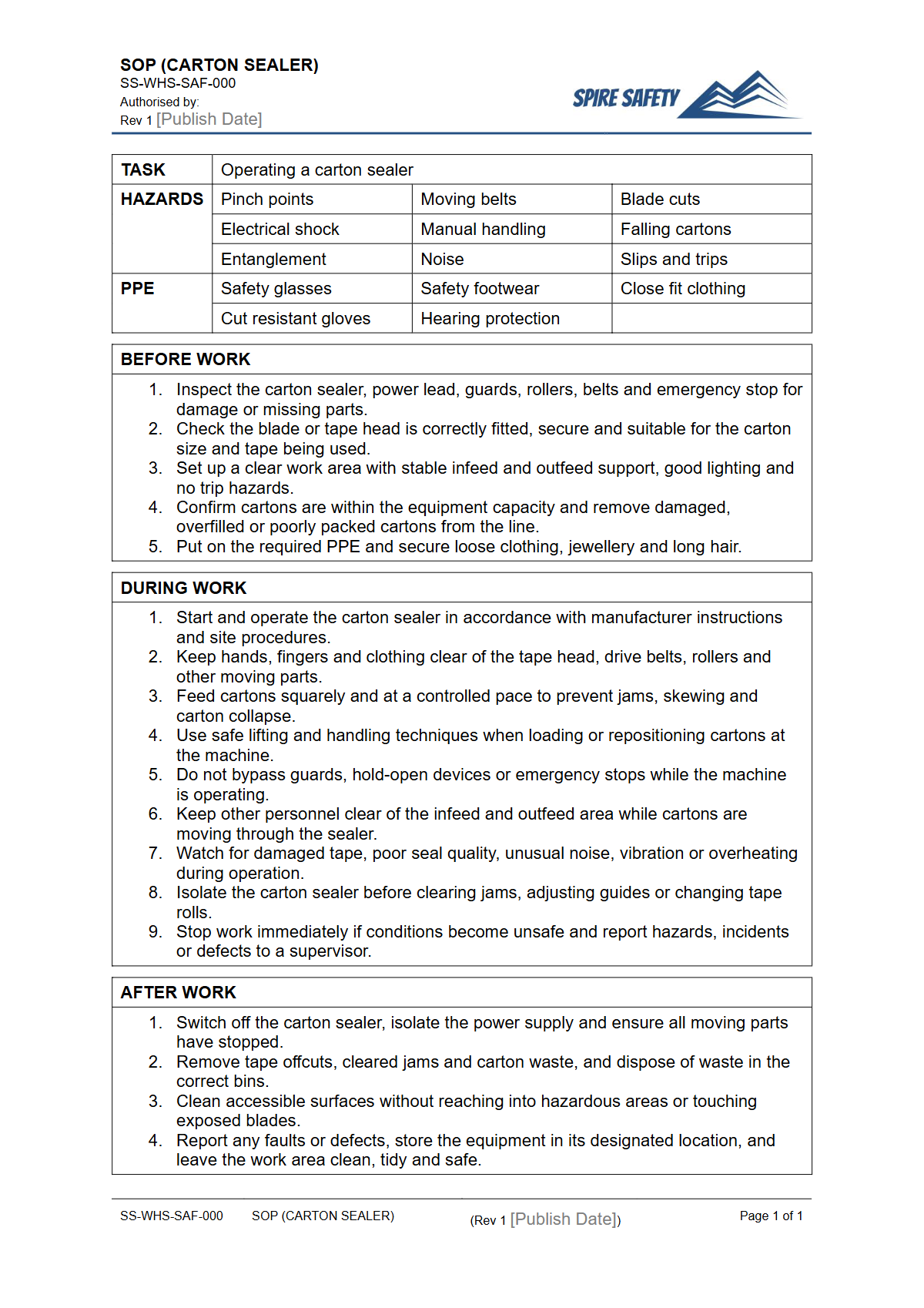
Download our Free Safe Operating Procedure (Carton Sealer) Template. This DOCX and PDF resource helps you outline safe work steps for carton sealing machinery.
Free Safe Operating Procedure (Carton Sealer) Template
DOCX • 126 KB + PDF
Updated Oct 2026
No signup required
Purpose of the Free Safe Operating Procedure (Carton Sealer) Template
This free Safe Operating Procedure (Carton Sealer) template provides a structured framework for documenting the required steps to operate carton sealing machinery safely. A well-drafted SOP is a fundamental administrative control that helps a Person Conducting a Business or Undertaking (PCBU) fulfil their primary duty of care under Australian WHS legislation.
It formalises a safe system of work, identifies potential hazards associated with the machine, and specifies the control measures necessary to protect workers from harm.
Using this template helps standardise operator training, provides a clear reference for safe work practices, and forms a critical part of your overall safety documentation. It guides you in considering risks such as moving parts, pinch points, cutting blades, and electrical hazards, ensuring these are addressed within your operational processes. Integrating specific SOPs like this one is a practical way to build out more robust WHS management systems.
Video walkthrough
How to use the Free Safe Operating Procedure (Carton Sealer) Template
This Safe Operating Procedure (Carton Sealer) template is designed as a comprehensive starting point, not a finished document. To make it effective and relevant, you must adapt it to your unique operational context.
Note: It is vital that you customise this document to reflect the specific make and model of the carton sealer in your workplace, your site-specific risks, and your existing control measures. We provide this as a guide; you are responsible for ensuring its accuracy and suitability for your business.
Follow these steps to implement the SOP:
- Consultation: Engage with the machine operators and maintenance personnel who use the equipment daily. Their direct experience is invaluable for identifying practical hazards and effective controls.
- Risk Assessment: Conduct a specific risk assessment for the carton sealer. Use the findings to populate the 'Hazards' and 'Controls' sections of the template.
- Populate the Sections: Fill in all relevant fields, including required Personal Protective Equipment (PPE), pre-operational checks, step-by-step operating instructions, and procedures for safe shutdown, cleaning, and clearing jams.
- Training: Train all operators on the finalised SOP. Keep records of this training to demonstrate competency.
- Display and Review: Make the SOP easily accessible near the machine. Schedule regular reviews to ensure it remains current. The principles are similar for other common workplace plant, such as those detailed in our Free Air Compressor SOP Template.
When to use it
A carton sealer SOP is a dynamic tool used throughout the equipment's lifecycle in your workplace. It should be formally used for inducting and training new operators, ensuring they understand the approved safe method of work from the outset.
It also serves as a critical reference for supervisors and workers, particularly for tasks that are performed infrequently, such as specific maintenance activities or troubleshooting.
Furthermore, the SOP is an essential document during safety audits and inspections, demonstrating that a systematic approach to managing plant risk is in place. After any incident or near-miss involving the carton sealer, the SOP should be reviewed as part of the investigation to determine if procedures were followed and if they need improvement. These documents are often key pieces of evidence examined during formal WHS compliance auditing.
Who should use it
While operators are the primary end-users of the SOP during their daily tasks, several roles within an organisation are responsible for its development and implementation. WHS managers and supervisors should lead the creation, customisation, and review process, ensuring it aligns with legislative requirements and company policy.
They are also responsible for delivering training and verifying that operators understand and follow the procedure.
The PCBU holds ultimate responsibility for ensuring that safe systems of work, including SOPs, are established and maintained. Operators must use the SOP to guide their work, perform pre-start checks, and report any faults or hazards. Every operator must be deemed competent before using the equipment, a principle that applies to all plant, from simple machines to complex equipment like that detailed in our FREE Telehandler SOP Template.
Key Hazards of Carton Sealers
While seemingly simple, carton sealers present several significant hazards that must be controlled. Your SOP should clearly address:
- Mechanical Hazards: These are the most common risks. They include pinch and nip points from belts and rollers, entanglement risks from moving drive components, and laceration risks from tape-cutting blades. Effective guarding is the primary control for these hazards.
- Electrical Hazards: Faulty wiring, inadequate insulation, or exposure to moisture can create risks of electric shock. The SOP should mandate pre-start checks of cables and ensure lockout/tagout procedures are followed for maintenance.
- Ergonomic Hazards: Repetitive movements from loading boxes, awkward postures while feeding the machine, and forceful exertions can lead to musculoskeletal injuries over time.
- Manual Handling: Lifting and moving boxes to and from the sealer can cause sprains and strains if not managed with proper lifting techniques or mechanical aids. These principles are also critical for tools like those covered in our FREE Circular Saw SOP Template.
Review and Maintenance of Your Safe Operating Procedure
An SOP is not a 'set and forget' document. To remain effective, it must be treated as a living document and reviewed regularly.
A review should be triggered by a set schedule (e.g., annually), whenever a new carton sealer model is introduced, if the process changes, or after any incident or near-miss. Consultation with the relevant workers should be a key part of the review process, as they can provide feedback on whether the procedure is still practical and effective.
Keep a version history on the document to track changes over time. Ensuring your procedures are up-to-date is a cornerstone of a healthy safety culture and demonstrates a proactive approach to risk management. To discover more downloadable documents to support your safety system, you can browse our entire free WHS resources library.
Common mistakes
Common mistakes to avoid
- Failing to isolate the machine from power before cleaning, maintenance, or clearing a jam.
- Using the template without customising it for the specific make and model of the carton sealer.
- Not providing adequate training to operators on the contents of the SOP.
- Overlooking ergonomic hazards like repetitive movements and awkward postures.
Legal references
Legal considerations
The following legal requirements may be relevant to this type of work.
- Work Health and Safety Act (Harmonised) — Provides the primary duties for protecting workers and other people from work health and safety risks.
- Work Health and Safety Regulations (Harmonised) — Sets out requirements supporting the management of workplace hazards and risks.
The following codes may be relevant to this type of work.
- Managing WHS Risks Code of Practice — Provides practical guidance on identifying hazards, assessing risks and applying effective controls.
- Work Health and Safety Consultation, Cooperation and Coordination Code of Practice — Provides practical guidance on consulting workers and coordinating with other duty holders.
- Managing the Work Environment and Facilities Code of Practice — Provides practical guidance on safe work environments, workplace facilities and related controls.
Did you know
Guarding is Key
According to Safe Work Australia, inadequate machine guarding is a leading cause of serious injury. Ensure all moving parts, rollers, and blades on your carton sealer are properly guarded.
Ergonomic Risk
Repetitive tasks associated with packing lines, including feeding boxes into a sealer, can lead to musculoskeletal disorders. Job rotation and ergonomic design are crucial controls.
FAQ
Frequently asked questions
01What is a Safe Operating Procedure (SOP) for a carton sealer?
02Is this carton sealer SOP template compliant with Australian WHS laws?
03Who is responsible for writing a carton sealer SOP?
04How often should I review my carton sealer SOP?
Share this resource
Free Safe Operating Procedure (Carton Sealer) Template
Browse Categories
How To Use It
- 1Download and open in Word or PDF.
- 2Replace the placeholders with your business details.
- 3Get it reviewed by a WHS specialist before rollout.
Need it customised?
Our WHS consultants can adapt this template to your site, run a gap analysis, or audit what you already have in place.
Book a Free Consultation WHS consulting servicesor call 1300 156 382
Related templates
- Free Safe Operating Procedure (Case Packer) Template
- Free Safe Operating Procedure (Cash Counting) Template
- Free Safe Operating Procedure (Cash Drawer Handling) Template
- Free Safe Operating Procedure (Cash Safe Access) Template
- Free Safe Operating Procedure (Cash Transit Handover) Template
- Free Safe Operating Procedure (Cask Handling) Template