
Free WHS Inspection (Excavation Site) Template
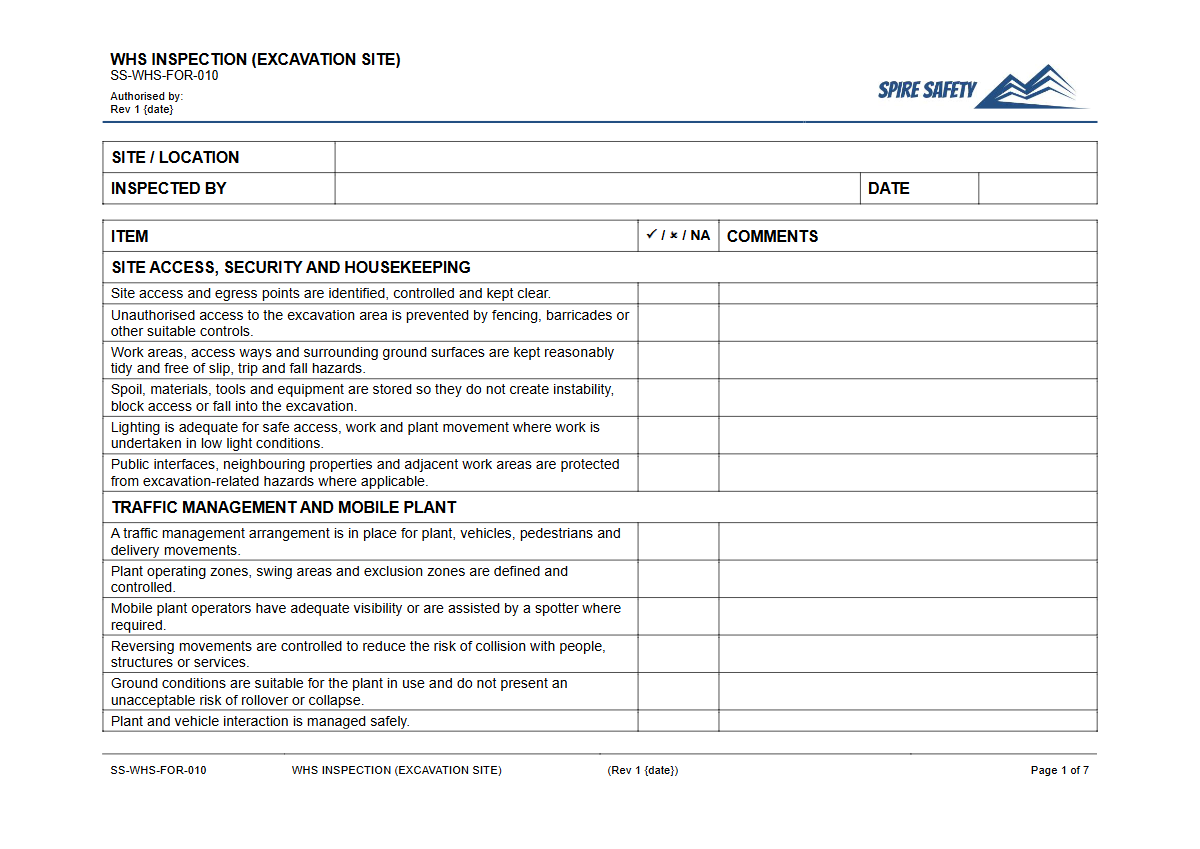
Download our Free WHS Inspection (Excavation Site) Template to formalise your safety checks and manage critical risks.
Free WHS Inspection (Excavation Site) Template
DOCX • 128 KB + PDF
Updated Oct 2026
No signup required
Purpose of the Free WHS Inspection (Excavation Site) Template
Excavation work is one of the most hazardous activities in the construction industry, with risks ranging from ground collapse to contact with underground services. This Free WHS Inspection (Excavation Site) Template provides a structured framework for systematically identifying and controlling these hazards.
Using a formal checklist helps ensure that critical safety measures are reviewed consistently, promoting a safer working environment. It assists Persons Conducting a Business or Undertaking (PCBUs) in meeting their primary duty of care by providing a practical tool for proactive risk management on site.
Regular, documented inspections are a cornerstone of any effective safety program. This template guides you through key checks for ground conditions, shoring and benching, access and egress, atmospheric monitoring, and plant and equipment safety. Integrating this inspection process into your daily routine helps create a robust, auditable record of your safety efforts, forming a crucial component of your broader WHS management systems.
Video walkthrough
How to use the Free WHS Inspection (Excavation Site) Template
This template is available as a DOCX file for easy editing and a PDF for straightforward printing. To get the most out of this resource, download the DOCX version and adapt it to the unique characteristics of your project.
This includes adding or removing checklist items based on the specific type of excavation, the ground conditions, the equipment in use, and the local environment. A generic checklist is a starting point, not a complete solution.
Important: This template provides a structured starting point aligned with Australian WHS practice. We recognise that every excavation site is different.
You must customise this document to address the specific hazards, personnel, and conditions of your workplace to ensure it is fit for purpose. Once customised, the Inspection should be completed by a competent person before and during excavation activities.
When to use this Inspection
A competent person should conduct an excavation inspection at regular intervals to ensure ongoing safety. These inspections should occur:
- Before any work shift begins.
- After any event that could affect the excavation's stability, such as a rainstorm, flood, or nearby vibration from heavy equipment or blasting.
- Whenever any new hazard is identified.
- At least daily when workers are present in or near the excavation.
Maintaining this frequency ensures that any changes in conditions are identified and controlled before they can lead to an incident. A proactive inspection schedule is far more effective than a reactive one.
Who should use it
This template is designed for use by competent persons responsible for overseeing safety on an excavation site. This typically includes roles such as:
- Site Supervisors or Foremen
- Project Managers
- WHS Officers or Safety Advisors
- Competent workers appointed to carry out inspections
The person conducting the inspection must have the knowledge and experience to identify excavation hazards and assess the effectiveness of control measures. They must also have the authority to stop work if they identify an immediate or imminent risk to health and safety.
Beyond the excavation itself, site security is paramount to prevent unauthorised entry, which poses a significant risk to both workers and the public. Reinforcing these principles with your team can be done effectively using our Site Security and Unauthorised Access Toolbox Talk Template to ensure everyone understands their responsibilities.
Excavation activities can also have a significant environmental impact if not managed correctly. Ensuring proper controls are in place for sediment and runoff is a key part of responsible site management.
You can use our Stormwater and Waterway Protection Toolbox Talk Template to train your team on best practices.
For organisations looking to verify the effectiveness of their overall safety processes, including site inspections, engaging an independent party can provide valuable insights. A comprehensive WHS compliance audit can help identify systemic gaps and opportunities for improvement across all your projects.
This resource is just one of many tools designed to support your WHS obligations. Explore our complete free WHS resources library for more templates, checklists, and toolbox talks to enhance your safety management system.
Common mistakes
Common mistakes to avoid
- Failing to identify and locate all underground services before digging begins.
- Stockpiling excavated material or heavy equipment too close to the edge of the excavation.
- Not providing safe and clear access and egress points for workers within the excavation.
- Assuming ground is stable without proper assessment, leading to inadequate or non-existent shoring or benching.
Legal references
Legal considerations
The following legal requirements may be relevant to this type of work.
- Work Health and Safety Act (Harmonised) — Provides the primary duties for protecting workers and other people from work health and safety risks.
- Work Health and Safety Regulations (Harmonised) — Sets out requirements supporting the management of workplace hazards and risks.
The following codes may be relevant to this type of work.
- Managing WHS Risks Code of Practice — Provides practical guidance on identifying hazards, assessing risks and applying effective controls.
- Work Health and Safety Consultation, Cooperation and Coordination Code of Practice — Provides practical guidance on consulting workers and coordinating with other duty holders.
- Managing the Work Environment and Facilities Code of Practice — Provides practical guidance on safe work environments, workplace facilities and related controls.
Did you know
Weight of Soil
A single cubic metre of soil can weigh as much as 1.5 tonnes, equivalent to a small car. A trench collapse can happen in seconds, giving workers little to no time to escape.
FAQ
Frequently asked questions
01What is the difference between an excavation and a trench?
02What are the main hazards on an excavation site?
03How often should excavation inspections be carried out?
04Does this template replace the need for a Safe Work Method Statement (SWMS)?
Share this resource
Free WHS Inspection (Excavation Site) Template
Browse Categories
How To Use It
- 1Download and open in Word or PDF.
- 2Replace the placeholders with your business details.
- 3Get it reviewed by a WHS specialist before rollout.
Need it customised?
Our WHS consultants can adapt this template to your site, run a gap analysis, or audit what you already have in place.
Book a Free Consultation WHS consulting servicesor call 1300 156 382