
Free WHS Inspection (Cargo Terminal) Template
Download our Free WHS Inspection (Cargo Terminal) Template. A structured starting point to help identify hazards and control risks in port operations.
Free WHS Inspection (Cargo Terminal) Template
DOCX • 129 KB + PDF
Updated Oct 2026
No signup required
Purpose of the Free WHS Inspection (Cargo Terminal) Template
Cargo terminals are dynamic, high-risk environments with constantly moving vehicles, heavy machinery, and complex logistical operations. Proactively identifying and managing hazards is fundamental to preventing incidents and ensuring worker safety.
This Free WHS Inspection (Cargo Terminal) Template provides a structured framework for systematically examining your worksite, helping you recognise potential risks before they lead to injury or damage.
Using this template helps a Person Conducting a Business or Undertaking (PCBU) meet their primary duty of care. It formalises the inspection process, creating a documented record of hazards identified and corrective actions taken.
Regular, documented inspections are a cornerstone of effective WHS management systems, demonstrating a clear commitment to workplace health and safety.
Video walkthrough
How to use the Free WHS Inspection (Cargo Terminal) Template
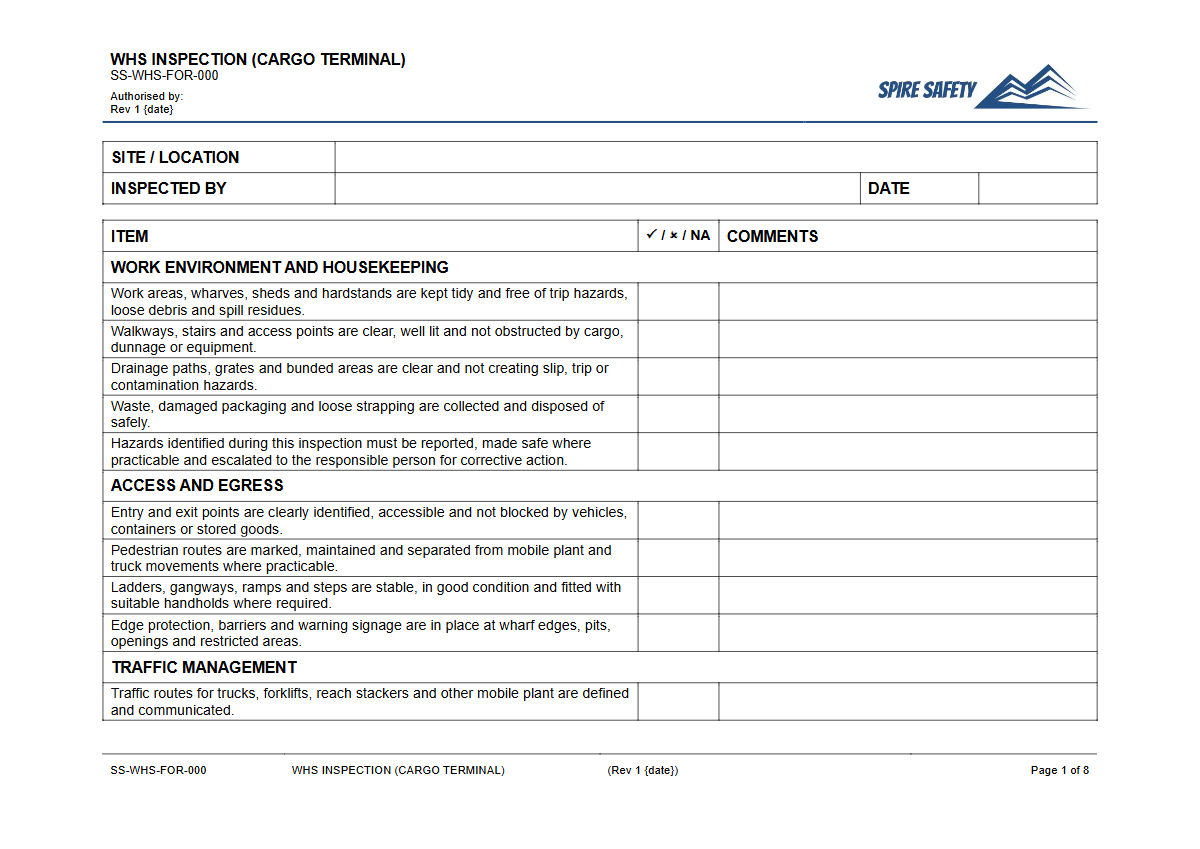
This Free WHS Inspection (Cargo Terminal) Template is available for download in both DOCX for easy editing and PDF for straightforward printing. The checklist is designed as a comprehensive guide covering common hazards found in cargo terminal environments, from traffic management and container stacking to manual handling and emergency preparedness.
To use the template effectively, follow these steps:
- Download the DOCX file and open it in your preferred word processor.
- Review each section and checklist item, adding, removing, or modifying points to align with the specific equipment, layout, and procedures of your terminal.
- Conduct the inspection by walking through the site and methodically checking each item. Record 'Safe', 'At Risk', or 'N/A' for each point.
- For any 'At Risk' items, provide detailed comments and photographic evidence where possible.
- Assign corrective actions, responsible persons, and due dates in the designated section to ensure accountability and timely resolution.
- Complete the sign-off section to finalise the inspection record.
Note: This template is a starting point aligned with Australian WHS principles. It is essential that you customise it to reflect the unique risks and operational realities of your specific workplace.
We cannot be responsible for its application as-is without your thorough review and adaptation.
Key Areas Covered in the Inspection
Our WHS Inspection (Cargo Terminal) Template is organised to cover the critical safety domains specific to port and terminal operations. Key sections prompt you to assess:
- Traffic Management: Segregation of pedestrians and vehicles, speed limits, signage, and the condition of roadways and access points. It's also important to check the operational status of site entry points, which can be formalised using a pre-start checklist for a boom gate.
- Plant and Equipment: Condition of cranes, reach stackers, forklifts, terminal tractors, and other mobile plant.
- Container Handling: Stability of container stacks, safe lashing/unlashing procedures, and condition of twist locks and lashing equipment.
- Slips, Trips, and Falls: Housekeeping, cable management, lighting, and the condition of walkways and access ladders.
- Hazardous Substances & Dangerous Goods: Correct storage, segregation, placarding, and availability of spill kits and Safety Data Sheets (SDS).
- Emergency Preparedness: Accessibility and serviceability of fire extinguishers, first aid kits, emergency exits, and communication systems.
When to use it
This inspection template is designed for periodic, in-depth workplace safety assessments. The ideal frequency depends on the size and complexity of your operation, but a common schedule is monthly or quarterly.
It should also be used following an incident, after the introduction of new machinery or work processes, or in response to concerns raised by workers or Health and Safety Representatives (HSRs).
While this template is for scheduled inspections, it does not replace the need for daily pre-operation checks on specific plant. For instance, operators should still complete a daily pre-start checklist for an electric hoist before its first use of the day to ensure it is safe for operation.
Who should use it
This template is designed for use by personnel with the authority and competence to identify workplace hazards and recommend controls. This typically includes:
- WHS Managers or Advisors
- Site or Operations Supervisors
- Health and Safety Representatives (HSRs)
- Members of the WHS Committee
The person conducting the inspection should be familiar with cargo terminal operations and have received training in hazard identification and risk assessment. Involving workers and HSRs in the inspection process is a valuable way to leverage their direct operational knowledge and foster a positive safety culture.
From Inspection to Action
An inspection's value lies not in the document itself, but in the actions that follow. Once completed, the findings must be analysed to prioritise risks and implement effective controls.
Significant or systemic issues identified during walkthroughs may signal the need for a more formal WHS compliance audit to investigate root causes.
For specialised areas, such as refrigerated container bays, findings may prompt a review of specific procedures or the introduction of targeted checklists, like one for a walk-in freezer or reefer unit. By consistently turning inspection findings into concrete improvements, you can drive continuous enhancement of your safety performance. Find more templates and checklists in our free WHS resources library to support your safety efforts.
Common mistakes
Common mistakes to avoid
- Failing to adequately customise the template to the specific machinery and layout of the terminal.
- Not assigning clear responsibility and deadlines for corrective actions, resulting in no follow-up.
- Using the inspection as a 'tick-and-flick' exercise without genuine observation and critical thinking.
- Neglecting to train inspectors on hazard identification and the specific risks of the work area.
Legal references
Legal considerations
The following legal requirements may be relevant to this type of work.
- Work Health and Safety Act (Harmonised) — Provides the primary duties for protecting workers and other people from work health and safety risks.
- Work Health and Safety Regulations (Harmonised) — Sets out requirements supporting the management of workplace hazards and risks.
The following codes may be relevant to this type of work.
- Managing WHS Risks Code of Practice — Provides practical guidance on identifying hazards, assessing risks and applying effective controls.
- Work Health and Safety Consultation, Cooperation and Coordination Code of Practice — Provides practical guidance on consulting workers and coordinating with other duty holders.
- Managing the Work Environment and Facilities Code of Practice — Provides practical guidance on safe work environments, workplace facilities and related controls.
Did you know
Stevedoring Risks
The stevedoring industry, which involves loading and unloading ships in ports, is recognised as one of Australia's highest-risk industries due to the interaction of heavy machinery, mobile plant, and workers in a confined, fast-paced environment.
The Hierarchy of Controls
When addressing hazards found during an inspection, you must apply the hierarchy of controls. This means prioritising higher-level controls like elimination and substitution over lower-level controls like administrative actions or PPE.
FAQ
Frequently asked questions
01What is the main difference between a WHS inspection and a WHS audit?
02How often should cargo terminal inspections be conducted?
03Can this template be used for other types of terminals?
04Who is responsible for actioning items from a cargo terminal inspection?
Share this resource
Free WHS Inspection (Cargo Terminal) Template
Browse Categories
How To Use It
- 1Download and open in Word or PDF.
- 2Replace the placeholders with your business details.
- 3Get it reviewed by a WHS specialist before rollout.
Need it customised?
Our WHS consultants can adapt this template to your site, run a gap analysis, or audit what you already have in place.
Book a Free Consultation WHS consulting servicesor call 1300 156 382